Only about 20-30 percent of canine urine samples submitted to the lab are going to be positive, which means that the majority of canine urine samples are going to get a negative result, and you’re not going to get susceptibility data to tell you how to treat that patient. The idea behind in-house culturing is that it's simple, it's inexpensive for clients, and you can rule out a lot of cases that don't need that additional susceptibility testing the lab provides. A negative in-house culture has just as much value as the send-out test.
Tufts at Tech and Foster Hospital Clinicians Publish How-To Video on Simple, Affordable In-House Urine Cultures
Technical tutorial among the first videos featured in JAVMA
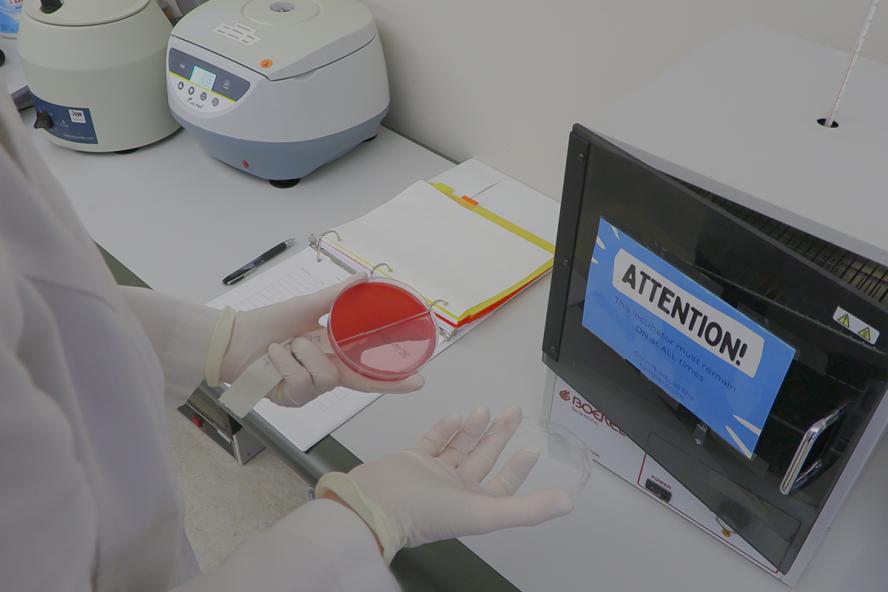
In ongoing efforts to expand access to veterinary care and promote antimicrobial stewardship, the clinicians at Tufts at Tech Community Veterinary Clinic and Henry and Lois Foster Hospital for Small Animals (FHSA) at Cummings School of Veterinary Medicine at Tufts University teamed up to create a technical tutorial video published in the Journal of the American Veterinary Medical Association (JAVMA). The tutorial provides detailed instructions for conducting a validated, low-cost technique regularly practiced at Tufts at Tech to the greater veterinary community.
The open-access technical tutorial video, “Plating canine urine cultures in the veterinary clinic,” was featured in the February 2026 issue of JAVMA. The seven-minute video demonstrates step-by-step how to plate, incubate, and interpret canine urine cultures to screen for bacteriuria, and includes safety procedures, necessary medical equipment, and an accompanying written guide with images of commonly seen organisms, such as E. coli. This is one of the first 50 technical tutorial videos selected for publication in JAVMA, a new format for the journal.
“The video is targeted to be practical, realistic, and implementable,” says co-author Dr. Claire Fellman (she/her), associate professor in the Department of Small Animal Clinical Sciences at Cummings School, on the Internal Medicine team at FHSA. “We haven't always been able to publish videos, so that's been a fun part of the process.”
The tutorial video follows a previous study conducted at Tufts at Tech validating this technique, also published in JAVMA. The prior study demonstrated that culturing urine samples in-house is a valid and inexpensive way to rule out bacteriuria.
Dr. Kayla Sample, VI19, VR24, (she/her) clinician at Tufts at Tech and assistant clinical professor of community medicine in the Department of Small Animal Clinical Sciences at Cummings School, was the lead author of that study and co-author of the video. “The original paper showed that this is valid and backed by literature. The point of this video is to take it from an article to something clinicians could realistically achieve in their practices—to reduce the barriers so they have the resources and knowledge base to implement this. The goal is increased care for everybody.”
Plating Canine Urine Cultures in the Veterinary Clinic
Learn about this low-cost setup and technique for performing in-house urine cultures.
Embedded within Worcester Technical High School, Tufts at Tech provides affordable veterinary care for pets in surrounding communities. Under the direction of Cummings School faculty, Tufts at Tech is a teaching clinic for fourth-year students on rotation and high school students in the veterinary assisting program. Tufts at Tech has always conducted urine cultures in-house to offer an inexpensive option for clients. This practice fits with Tufts at Tech’s overarching mission to expand access to veterinary care.
“Having been in practice for a long time, I understand the financial burden that reference laboratory cultures can put on pet owners,” says co-author Dr. Nicole Freeman, V02, (she/her) Tufts at Tech clinician and assistant clinical professor of community medicine in the Department of Small Animal Clinical Sciences at Cummings School. “We have a generation of students that we are teaching how to go out into practice and think about things differently.”
By publishing the paper and video, Cummings School clinicians are sharing this evidence-based, low-cost technique so that it can be readily adopted by veterinary clinics and hospitals to screen patients presenting with urinary conditions for bacteriuria, in lieu of submitting samples to a reference lab for culture and susceptibility (C&S) testing, at a cost to pet owners of potentially a few hundred dollars.
“That high school students have been effectively doing this at Tufts at Tech for years shows that it's an accessible procedure, and certainly technicians and assistants in a private practice setting can learn how to do it,” says lead author of the video, Dr. Jennifer Grady, V12, (she/her) Tufts at Tech clinician and assistant clinical professor of community medicine in the Department of Small Animal Clinical Sciences at Cummings School.
In the original Tufts at Tech study, 75 percent of the urine samples cultured were negative for bacteriuria, meaning that urinary tract infection (UTI) was not the cause of the patients’ clinical problems.
“Only about 20-30 percent of canine urine samples submitted to the lab are going to be positive, which means that the majority of canine urine samples are going to get a negative result, and you’re not going to get susceptibility data to tell you how to treat that patient,” says Grady. “The idea behind in-house culturing is that it's simple, it's inexpensive for clients, and you can rule out a lot of cases that don't need that additional susceptibility testing the lab provides. A negative in-house culture has just as much value as the send-out test.”
Antibiotics are prescribed to treat UTIs, but not other urinary tract conditions. Fellman was pulled in for the first study and the video for her expertise in antimicrobial stewardship, advocating a judicious approach to prescribing antibiotics to avoid diminishing their effectiveness in treating patients and subsequently strengthening pathogens’ resistance. She connected with microbiologists from the University of Pennsylvania’s School of Veterinary Medicine to further ensure the video provides sufficient guidance for safely running cultures in clinics and hospitals.
“People are looking for these kinds of tools to be able to realize stewardship,” says Fellman. “By prescribing antibiotics when they're not needed, the pathogens become more resistant, and then the infections become less treatable. When we can use less antibiotics, there's less development of resistance, and that's really where these cultures are most helpful, when there's not a bacterial infection. There’s still a lot of just-in-case prescribing when it’s not clear whether an infection is present. People can do cultures in-house now with the support of this video, and then hopefully reduce antibiotic use and resistant bacteria.”
Services, hospitals, and clinics across Cummings School often tap into one another’s areas of expertise for patient cases and research studies.
“It was nice to see the collaboration across teams in different locations with different academic areas of interest,” says Freeman. “That's the fun thing about being part of an academic team, but also being part of this particular group of people. Everybody had a nice level of enthusiasm for working together.”
The Tufts at Tech team especially valued Fellman’s research expertise, while Fellman compliments the Tufts at Tech clinicians for their impact training students in community medicine, “I'm having more and more residents that want to go to Tufts at Tech because they find such a wonderful experience. It's a nice culture of gratitude over there, and importantly, what they've told me is that they see other ways to approach cases. All these research efforts and clinical efforts support everyone's awareness of the ways we can serve our clients.”
The authors also gave high praise to Jeff Poole, photographer and videographer on Cummings School’s Communications and Marketing team, who handled the technical aspects of the video.
Tufts at Tech and FHSA’s Internal Medicine teams are currently working together on another access to care study, focused on antimicrobial stewardship in treating canine UTIs.