Newborn Giraffe from Franklin Park Zoo Treated at HLA
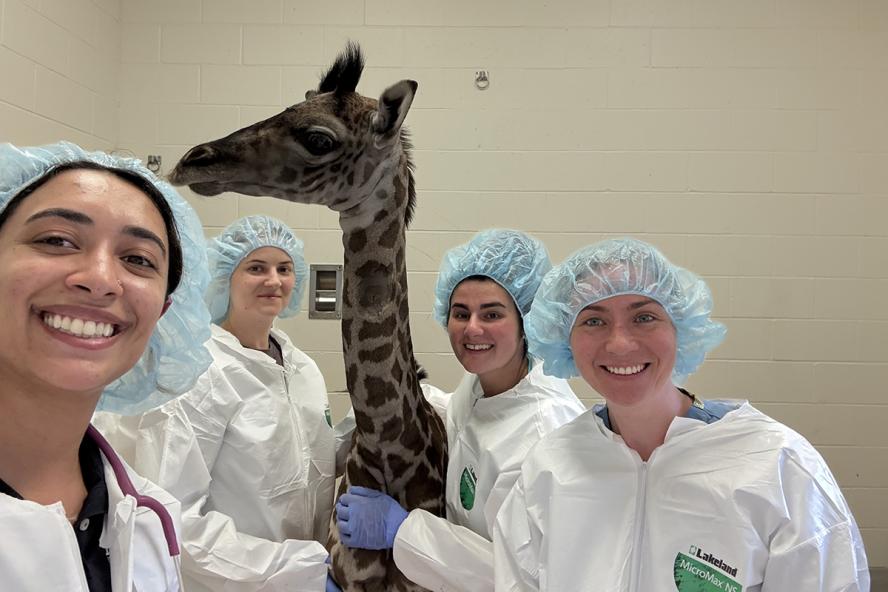
The Franklin Park Zoo in Boston welcomed a newborn male Masai giraffe in early August. Over his first few days of life, the calf struggled to nurse. Without his mother's milk to provide nutrition and critical antibodies, he required intensive care to survive. In a close collaboration between the Franklin Park Zoo and Hospital for Large Animals (HLA) at Cummings School of Veterinary Medicine at Tufts University, the giraffe returned to health and successfully reunited with his mother.
Monitoring the calf after his birth, Dr. Brianne Phillips (she/her), associate veterinarian at Zoo New England's Franklin Park Zoo and Stone Zoo, observed that he did not nurse in his first 24 hours. During his neonatal exam, she determined that he did not have a suckle reflex. Over the next three days, she and her team attempted to bottle-feed him, but without success, so they tube-fed the giraffe with colostrum and milk replacer.
Phillips consulted with Dr. Daniela Bedenice, faculty member on the Internal Medicine team at HLA's Cummings School. Phillips confers with Bedenice and other clinicians at Cummings School hospitals when needed for specialized expertise in treating the animals in her care. A number of Franklin Park Zoo animals have been patients at HLA and Henry and Lois Foster Hospital for Small Animals (FHSA) over the years.
The calf's mother, Amari, was treated by Bedenice for the same condition as her son after she was born, failure of transfer of passive immunity, or inadequate first milk intake. Not ingesting the colostrum from the mother deprives calves of nutrition and antibodies crucial to the immune system. This condition occurs across species of neonates, including foals, newborn ruminants, and crias.
Bedenice says of Amari's calf, "The lack of nursing is both a health concern and a nutritional concern. It becomes a snowball effect. The animal gets weaker from lack of nutrition, and also lacks antibodies, therefore sets itself up for secondary infection. We have seen a fair number of sick giraffe calves over the years."
The HLA team published a retrospective case study series on hospitalized giraffe calves with this condition (including Amari). Phillips and Bedenice suspected that Amari's calf had neonatal maladjustment, a neurological condition in which animals do not show typical behaviors shortly after birth.
"Newborn large animals should be able to stand within an hour and nurse within two hours so that they can keep up with the herd in a more natural setting," says Bedenice. "They also need to meet these milestones to absorb enough colostrum, which protects them against infection."
Over his first few days, Phillips and Bedenice weighed whether to keep the calf at the zoo or refer him to HLA. "It's a serious step to separate the offspring from the dam; we don't do that lightly," says Bedenice.
By the third day, the giraffe had not nursed or accepted milk from a bottle but relied on repeated tube feeding instead. He began suffering from bloody diarrhea, indicating infection.
"The calf wasn't nursing on its own or taking bottle feeds, and with the fluid losses from diarrhea, he needed 24-hour, around-the-clock intensive care," says Phillips. "Dr. Bedenice is a wealth of knowledge and support. She has seen giraffe calves previously and managed their cases, so we knew that this calf was going to receive the care he needed. We had full confidence in her and in the rest of the clinicians and support staff at Tufts."
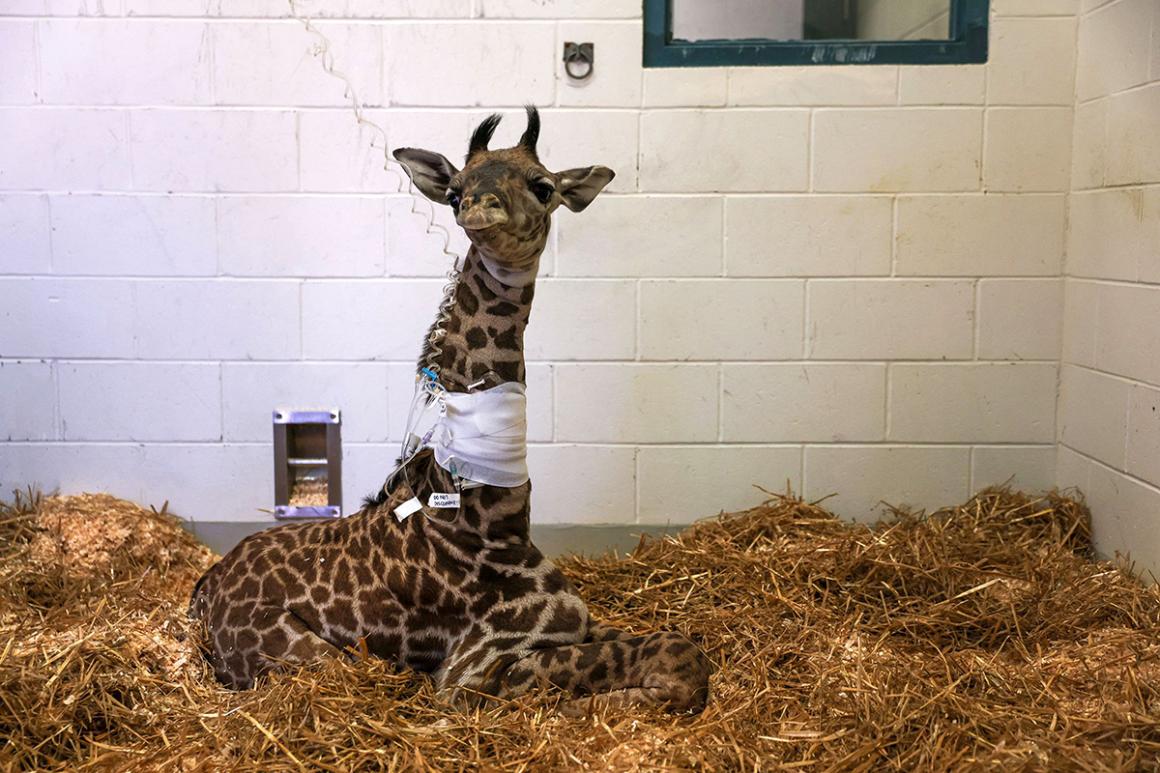
When the giraffe arrived at the emergency room at HLA, Dr. Stefanie Arndt, assistant clinical professor of large animal surgery, Dr. Ananya Mahalingam-Dhingra, large animal medicine resident, and a team of technicians and veterinary students conducted a physical exam, noting that he was lethargic and showed signs of diarrhea. The team sedated the giraffe to reduce his stress, drew blood to determine his level of dehydration, and took X-rays, revealing aspiration pneumonia, an infection of the lungs caused in this case by mis-swallowing and inhaling milk.
Arndt, Mahalingam-Dhingra, and the team worked quickly to stabilize the calf. They administered intravenous (IV) fluids for hydration and nutrients, antibiotics to stave off infection, and a plasma transfusion to provide antibodies.
"This showed me again how blessed we are at Tufts [Cummings School] to have such great teamwork; there were so many people involved," says Arndt, giving kudos to her fellow clinician, resident, and veterinary technicians who treated the giraffe in the ER.
The calf initially received intravenous nutritional support, and as soon as he gained strength, the veterinary technicians trained him to bottle feed. Over the next 10 days at HLA, the giraffe consistently improved. Initially, he would splay when he tried to stand and needed assistance for several days.
Phillips had been treating the giraffe for a corneal ulcer at the zoo. The Ophthalmology team at FHSA continued that treatment and monitored his progress until the ulcer and eye inflammation were resolved with antibiotics. Blood in the stool indicated that bacteria could have crossed into the bloodstream through an inflamed bowel wall, so sepsis was a significant concern. The calf remained on antibiotics to treat his aspiration pneumonia and ulcer, and to prevent sepsis, a potentially lethal condition in which organs become damaged in an overresponse to infection.
"He was at risk of becoming really ill, but he actually did very well. He never developed established signs of sepsis and responded to antibiotics and nutritional support," says Bedenice.
Dr. Mireya Becero-Lopez (she/her), large animal internal medicine resident at HLA, monitored the giraffe's progress and diagnostics throughout his stay at HLA. "It was incredibly rewarding to see the animal's progress—from being lethargic, weak, and unable to stand or feed, to walking around and drinking milk on his own. Seeing him back at the zoo with his mother was truly satisfying."
When the calf returned to Franklin Park Zoo, the animal care staff successfully reintroduced him to his mother.
On the giraffe's recovery, Bedenice says, "For these types of cases, success is dependent on the teamwork within the hospital and with the attending zoo veterinarians. The fact that the Franklin Park Zoo veterinarians and Tufts [Cummings School] have a very good working relationship makes it so much easier to be successful, because we can brainstorm and work together in making decisions."
Cummings School clinicians regularly consult with veterinarians at zoos and aquariums. Phillips collaborates with HLA clinicians on cases of sick neonates and hoofstock, with FHSA faculty regarding small zoo animals, and with the theriogenologists at Cummings School on reproductive issues.
"Specialists serve as a resource for more complex questions that are translatable between domesticated and non-domesticated species. Teamwork sets us up for success to manage a patient that has complex medical concerns by drawing on each individual's expertise," says Bedenice.
"We really value the specialists at Tufts [Cummings School]," says Phillips. "There are many times when we reach out to a specialist or bring them on-site to look at a case. We're very grateful and appreciative to have Tufts [Cummings School] as a resource for our animals."
Department:
Hospital for Large Animals