People think of veterinary medicine and human medicine as separate, but there are so many overlaps, and not just zoonotic diseases, but the human-animal bond in general. Having both perspectives will help me in the future—public health and animal health.
Meet Cara Kaminski, VG25, V29, MG29 (M.P.H.)
Kaminski’s graduate studies at Cummings School integrate policy, public health, and veterinary medicine
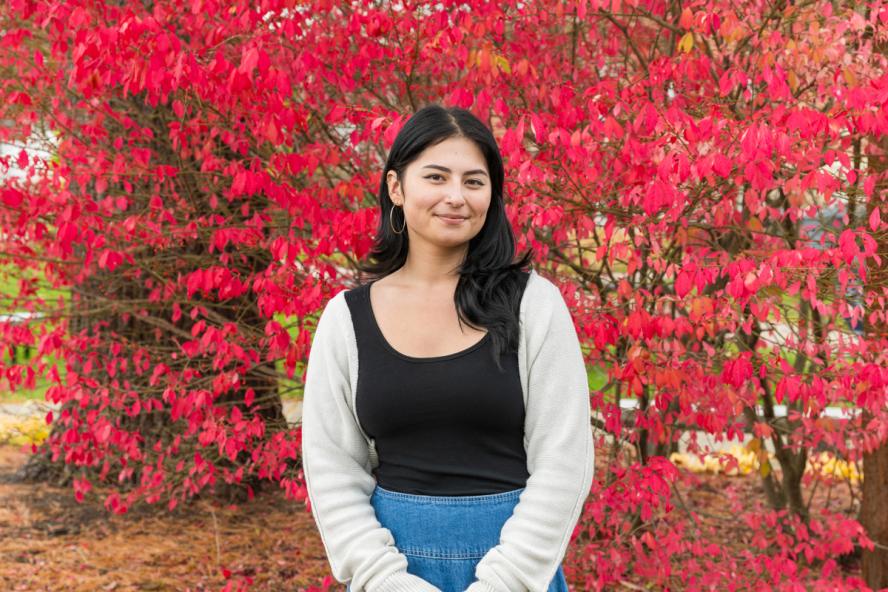
Cara Kaminski, VG25 (MAPP), V29, MG29 (M.P.H.), (she/her) originally planned on a career in art restoration. Volunteer work, research with big brown bats, and several undergraduate courses inspired a new path of studies, bringing her here to Cummings School of Veterinary Medicine at Tufts University. Her experience in the Master of Science in Animals and Public Policy (MAPP) program led to an externship at the Massachusetts Veterinary Medical Association (MVMA), and this semester she began the dual-degree D.V.M./Master of Public Health (M.P.H) program.
Kaminski earned her Bachelor of Arts at Brown University, with a double major in biology and visual arts. She received numerous awards for both her artwork and songwriting in high school and college, and worked as a gallery assistant for the Providence Art Club and a graphic web designer for the Sandra Bornstein Holocaust Education Center.
Throughout her time at Brown, Kaminski also volunteered at the Providence Animal Rescue League. "That's where I found I enjoyed taking care of animals. I'd grown up with medicine in my life; both of my parents are human physicians. I realized I was able to take that knowledge I had grown up with and apply it to animals," she says.
An animal behavior course further piqued her interest. Her professor was the primary investigator on a research study into the behavior of big brown bats, specifically how the bats utilize biosonar frequencies. Kaminski worked as a research assistant in her professor's lab, training and feeding several of the bats in the study.
"The bats' frequency hops to distinguish different objects," she explains. "They send out multiple calls and utilize different frequencies. That modulation lets them digest all that knowledge without interference from other bats or cluttered environments."
Sociology and law courses fostered an interest in public policy. While art remained a focus in her life, Kaminski decided she'd like to work with animals and tie in policy work.
Her first stop after graduating was the MAPP program at Cummings School.
"I knew ultimately I wanted to go into veterinary medicine, but I was looking for something prior to that to diversify my knowledge," she says. "I could impact not just individual animal care, but also learn how to influence the policies that impact animals as a whole."
The one-year MAPP program explores human-animal relationships, animals in society, and the role of public policy. Students customize the program to their area of interest by completing a research track or an applied track. The latter includes an externship in the field.
"I really appreciated my time in the program," Kaminski says. "I liked the personability and the opportunity to really tailor it to what you want."
Kaminski has high praise for the MAPP faculty and professors from other departments who teach modules in the program. While exploring externship opportunities, the track leader of the D.V.M./M.P.H. program, Dr. Meera Gatlin, V16, MG16 (M.P.H.), connected her with MVMA. Gatlin, Assistant teaching professor in the Department of Infectious Disease and Global Health at Cummings School and clinical assistant professor of Public Health and Community Medicine at Tufts Medical School became her mentor for the externship.
"Tufts [Cummings School] is a wonderful community. There's so much department cross-over, and everyone there is a resource," Kaminski says.
During her eight-month externship with MVMA, Kaminski focused on veterinary advocacy and policy communication, putting her MAPP skills directly to use. She attended meetings of MVMA's Government Relations & Advocacy Committee, Animal Welfare Committee, and lobbying groups. She was a part of MVMA's opposition to a telemedicine bill proposed in Massachusetts that would allow annual veterinary visits to be conducted online. She wrote a one-page flyer for legislators stating the reasoning behind MVMA's opposition and a tip sheet for veterinarians testifying against the bill. She participated in Animal Lobby Day and Protect Animals from Rodenticide Lobby Day at the Massachusetts State House. During the lobbying days, she met up with MAPP classmates Ashley Krashuk, on externship with the MSPCA, and Vikram Mathur, during his externship with Animal Rescue League Boston.
Kaminski also took part in the American Veterinary Medical Association's legislative fly-in event in Washington, DC, meeting with her representative on Capitol Hill to campaign for federal legislation, including the Rural Veterinary Workforce Act. She lobbied alongside Dr. Brie Beberman, VG15, a MAPP alum also working for MVMA.
The MAPP cohort became a tight-knit group over the year. Kaminski served as co-ambassador of the class, a liaison for fellow students with faculty, and hosted monthly events for the cohort.
After the MAPP program wrapped up in August, Kaminski started the dual-degree D.V.M./M.P.H. program offered by Cummings School and Tufts School of Medicine. The four-year program combines veterinary medicine training with public health, with courses on food safety, epidemiology, infectious disease, and global and environmental health, and includes a D.V.M./MPH-specific clinical rotation.
“People think of veterinary medicine and human medicine as separate, but there are so many overlaps, and not just zoonotic diseases, but the human-animal bond in general,” says Kaminski. “Having both perspectives will help me in the future—public health and animal health.”
Art is still a constant in Kaminski's life—lately she has been painting animals. As for career plans, she is keeping her options open as she continues learning and exploring the possibilities in policy, public health, and veterinary medicine through her studies at Cummings School.
Advocate and Make a Difference in the World
Cummings School’s M.S. in Animals and Public Policy examines the changing roles of animals in our society. Students learn to effectively evaluate research and policy arguments preparing them for careers in animal protection agencies, conservation initiatives, and environmental advocacy organizations.