We work hard to provide the best care possible for our patients. We also have varied interests within cardiology, and those passions build a service that provides well-rounded quality care. As a team driven by shared interest in academia, literature, and procedures, we are also able, with our mixed knowledge base, to provide the students and residents with a comprehensive learning environment.
Hearts are in Good Hands at Foster Hospital
Cardiology service expands offering cutting-edge medicine and community partnership to pets facing complex heart conditions
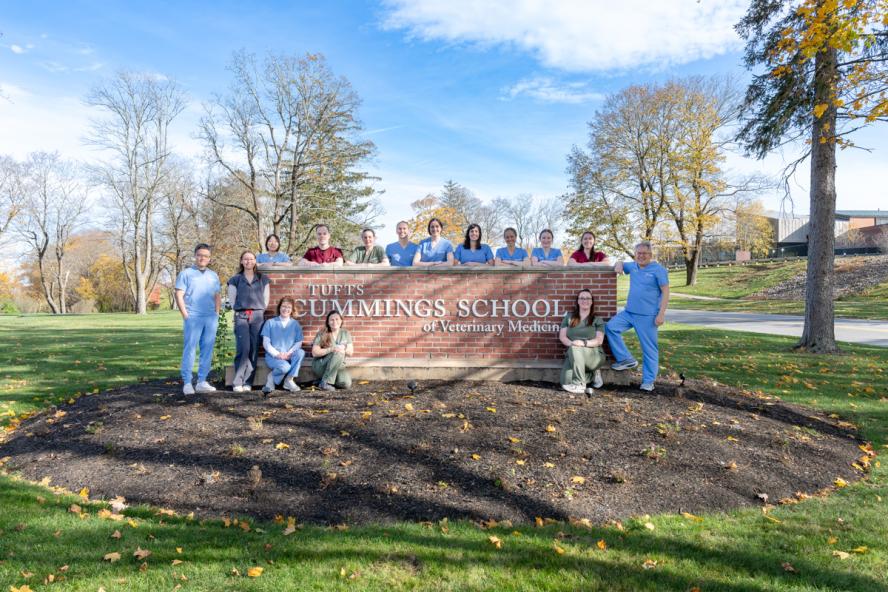
To meet the needs of cardiac patients from across New England, new faculty members have joined the Cardiology Service at Henry and Lois Foster Hospital for Small Animals (FHSA) at Cummings School of Veterinary Medicine at Tufts University. Available for referrals and consultations, the faculty clinicians are leaders in cardiology research, utilize advanced equipment and technologies, and draw on decades of expertise to diagnose and treat animals with cardiovascular diseases.
“The Tufts Cardiology team is made up of a very cohesive group of faculty, residents, technicians, and liaisons who have a shared goal of providing excellent patient care,” says Emily Karlin, D.V.M., DACVIM (Cardiology), V08, associate clinical professor in the Department of Clinical Sciences at Cummings School. “We strive to work as a team to provide the absolute best care possible for every patient of the Cardiology service. This includes medical and surgical management of pets with heart disease, consultations for other services within the hospital, and cardiac evaluations of farm animals, pet birds, small mammals, and zoo animals.”
For more than 30 years, John Rush, D.V.M., DACVECC, DACVIM (Cardiology) has served the patients of FHSA. “I might be described as a faculty member with many scattered areas of interest,” says Rush. “I enjoy clinical management of cases and using those cases to help push new knowledge in clinical medicine.” Rush currently researches new medications for heart disease and the role of nutrition in cardiac disease. On the clinical side, he works to advance cardiac catheterizations, interventional procedures, and cardiopulmonary resuscitation.
A student in one of Rush’s cardiology courses was Dr. Karlin. After earning her D.V.M. at Cummings School, she took on an equine internship and practiced ambulatory equine and large animal medicine for several years before returning for her residency in cardiology, an interest seeded in Rush’s class. She has published case reports on novel cardiac interventions and investigated the use of smart collar technology to track breathing rates in cats.
Vicky Yang, D.V.M., Ph.D., DACVIM (Cardiology), V09, associate professor in the Department of Clinical Sciences, began her career as an engineer. “My love for animals helped me make the transition to veterinary medicine. I was drawn to cardiology because of its connection with engineering. The heart is a highly efficient pump after all!” she says. “I love working with all of the specialists here at Tufts. Tufts provided a nurturing research environment for me to continue with my work.”
I-Jung Bernard Chi, D.V.M., Ph.D., DACVIM (Cardiology), joined FHSA’s Cardiology service last winter as assistant professor in the Department of Clinical Sciences and is the team’s new expert on technologies for advanced cardiac procedures. At Colorado State University, he focused on advanced cardiac imaging and interventional cardiology. He led the adoption of cardiac CT and advanced transesophageal echocardiography (TEE) to help diagnose and treat structural and congenital heart diseases at FHSA. The TEE technology at FHSA utilizes the latest human pediatric ultrasound probe to image the animal heart through the esophagus during transcatheter cardiac procedures.
These new technologies have helped tremendously in planning and performing catheter-based cardiac procedures in animals. Transcatheter edge-to-edge repair (TEER) is a minimally invasive procedure performed at only a few veterinary institutions to treat degenerative mitral valve disease (the most common heart disease) in dogs. “It’s the newest ultrasound technology and one of the first pediatric probes that can do 3D imaging of the heart. The new ultrasound system has been a major upgrade in our ability to perform interventional echocardiography, and the high-quality imaging has helped us tremendously in patient care,” says Chi. Additionally, the Cardiology Service at FHSA specializes in many catheter-based therapies for congenital heart diseases in young puppies and kittens. These animals were born with unique heart structures and physiology that require early diagnosis and intervention in the hands of experienced cardiologists.
Also distinguishing FHSA’s Cardiology service is the team’s veterinary nutritionist, Lisa Freeman, D.V.M., Ph.D., DACVIM (Nutrition), A86, V91, NG96, professor in the Department of Clinical Sciences. She has been at Tufts for almost 40 years, earning her undergraduate and veterinary degrees and Ph.D. before joining the faculty at Cummings School.
A canine patient Freeman treated at FHSA inspired the focus of her Ph.D., studying the role of fish oil in dogs with heart disease. “That was the start down this understudied area of nutrition and heart disease in dogs and cats. For most of my more than 25 years as a nutritionist, I’ve cared for patients with all types of medical conditions and conducted research to advance veterinary care in many areas. Several years ago, I moved into the Cardiology service, where I focus all of my clinical and research time on dogs and cats with heart disease.”
The newest faculty member in the Cardiology service is Hannah Melhorn, D.V.M., DACVIM (Cardiology), who first joined the team three years ago for her residency. Now assistant clinical professor in the Department of Clinical Sciences, Melhorn earned her D.V.M. at the University of California, Davis, and first came to Cummings School for her rotating internship. She has a special interest in exotic and zoo animal cardiology.
“The patients and team here are truly amazing,” says Melhorn. “There is a sincere family feel to the Cardiology service. I am lucky to have developed lasting relationships with many of the owners and their pets.” Melhorn expresses the patient-centered ethos of the team, “We work hard to provide the best care possible for our patients. We also have varied interests within cardiology, and those passions build a service that provides well-rounded quality care. As a team driven by shared interest in academia, literature, and procedures, we are also able, with our mixed knowledge base, to provide the students and residents with a comprehensive learning environment.”
In training the next generation of veterinary cardiologists, faculty work closely with students, residents, and interns, with direct involvement in the medical and/or surgical management of every patient.
The Cardiology team collaborates extensively with the other services at FHSA to provide advanced care for patients with heart disease, including the Anesthesia, Emergency Medicine and Critical Care, Internal Medicine, Surgery, Oncology, and Radiology teams.
“Heart disease is one of the most common diseases affecting dogs and cats,” says Freeman. “Our unique team is able to provide highly specialized, team-based care for pets and is also advancing knowledge about heart disease through research.”
Invitation to Collaborate
The Cardiology Service at Foster Hospital for Small Animals is committed to shared work and shared progress while serving the animals and veterinary community throughout Massachusetts and New England. Referrals and consultations on challenging cases requiring advanced hospital resources are welcomed from practitioners and specialists. We strive for effective communication and shared planning after tertiary care so patients may continue to follow up with their referral specialists and family veterinarians. When standard therapies have been exhausted, we partner with the Massachusetts Veterinary Medicine Association and enroll patients in clinical trials through our Clinical Research Shared Resource.
To reach the Cardiology Service at FHSA, please email cardiovet@tufts.edu or call Henry and Lois Foster Hospital for Small Animals at (508) 839-5395. For TEER and DMVD-specific referrals, please email teer@tufts.edu.
Meet the Cardiology Team
I-Jung Bernard Chi, D.V.M., Ph.D., DACVIM (Cardiology), earned his veterinary degree from National Taiwan University and his master’s degree in toxicology at Colorado State University. He stayed on at CSU for an internship in small animal medicine and surgery, a cardiology residency, and his Ph.D, exploring the cardiac imaging capabilities of advanced cardiac computed tomography (CT) scanners. His academic interests include transcatheter intervention and imaging for structural and congenital heart diseases, and innovations in medical devices and therapies.
Lisa Freeman, D.V.M., Ph.D., DACVIM (Nutrition), A86, V91, NG96, is a board-certified veterinary nutritionist embedded within the cardiology team—a unique combination not seen in other institutions. Her career has centered on how diet influences heart disease.
Emily Karlin, D.V.M., DACVIM (Cardiology), V08, is a Tufts graduate who returned for cardiology residency after time in equine and large animal practice. Her work spans clinical cardiology, veterinary education, and practical innovations, including work in cardiac interventions and early exploration of smart-collar technology to track breathing rates in cats.
Hannah Melhorn, D.V.M., DACVIM (Cardiology), trained at Tufts for her residency following her D.V.M. from UC Davis. She has a special interest in exotic and zoo animal cardiology and helps anchor the service’s culture of compassion and teaching.
John Rush, D.V.M., DACVECC, DACVIM (Cardiology), has been at Foster Hospital for most of his career. After cardiology residency training at the University of Wisconsin–Madison, his clinical focus has centered on catheter-based procedures and cardiopulmonary resuscitation, paired with studies of new medications and the role of nutrition in cardiac disease.
Vicky Yang, D.V.M., Ph.D., DACVIM (Cardiology), was trained as an engineer at Massachusetts Institute of Technology before earning her D.V.M. and completing cardiology residency at Tufts. The Yang Laboratory at Cummings School focuses on canine mitral valve disease, cardio-oncology, and translational medicine. In these endeavors, she works with colleagues at Tufts Medical Center, Massachusetts General Hospital, and the Oncology team and Clinical Trials Office at Cummings School (several clinical trials are currently accepting new patients).
Department:
Foster Hospital for Small Animals