All Hands on Deck to Treat Alligator that Swallowed a Training Toy
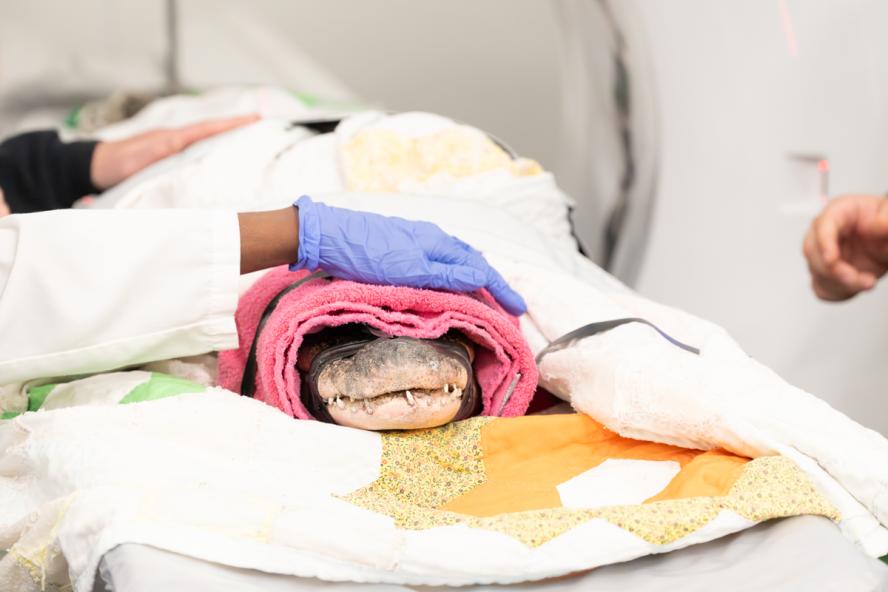
The American alligator has one of the most powerful bite forces of any animal at approximately 2,000 pounds per square inch—so when Allie decided to eat her Kong training toy, it was gone in an instant. Extracting the toy from her stomach is a longer story and took a dedicated aquarium director, ingenuity, and teamwork across four services at Henry and Lois Foster Hospital for Small Animals (FHSA) at Cummings School of Veterinary Medicine at Tufts University.
This chapter is the latest in a storied life for the alligator. While American alligators are native to southeastern states, Allie hails from Minnesota. A house pet for her first few years, Allie eventually grew too large (now five and a half feet long) and was surrendered to the Minnesota Herpetological Society and adopted by the Reptile and Amphibian Discovery Zoo. She spent the next decade travelling the state as an ambassador animal in their educational programs.
Allie took up residence at Living Shores Aquarium in Glen, New Hampshire, last January when the zoo closed. She lives on exhibit.
Sarah Fabbricotti (she/her), aquarium director of Living Shores, says of the alligator, “Allie is desensitized to humans, having been raised under human care, but still a fierce presence when entering her enclosure, especially when it is feeding time.”
While participating in target training, Allie swallowed a Kong rubber training toy. Target training conditions zoo and aquarium animals to recognize an object—in Allie’s case, the Kong toy—and associate it with positive reinforcement, typically food.
“Target training gives the animal a choice to move toward the target where a trainer can access or view the animal,” explains Fabbricotti. “Some facilities use this for enrichment, giving the animal mental stimulation. We use it to separate Allie from her roommates to feed safely and monitor her diet consumption.”
The Kong toy was attached to the end of her target training pole during her positive reinforcement training.
“She was very quick, and with her powerful jaws she was able to rip the Kong off the end and ultimately swallow it,” Fabbricotti recounts.
Allie was observed by the staff at Hopkinton Animal Hospital, but showed no clinical signs and seemed unaffected by the softball-sized toy in her stomach. The team waited for the toy to pass. After two months and still no Kong, Fabbricotti weighed the options.
“Our vet contacted Dr. Barboza and other specialists who theorized that Allie could exist with the Kong, as alligators in the wild swallow objects somewhat frequently. However, the risk of obstruction would remain. We ultimately decided to have the object removed and followed the referral Hopkinton gave us for Tufts [Cummings School], given their access to a scope and imaging equipment,” says Fabbricotti. “I grew up down the street from Tufts [Cummings School] and have always been aware of its reputation as a premier facility.”
Dr. Trinita Barboza (she/her) is an assistant professor in the Department of Small Animal Clinical Sciences at Cummings School, on FHSA’s Zoological Companion Animal Medicine (ZCAM) service. Prior to Allie’s appointment at FHSA, Fabbricotti and Allie’s primary veterinarians briefed Barboza on the alligator’s condition so that they could prepare.
“Allie is the first alligator to come to Foster Hospital,” says Barboza. “However, the faculty in our service are ACZM-trained [American College of Zoological Medicine]—we’re trained in zoological companion animal, zoo, aquatic, and wildlife medicine. During residency, we trained on species like this. Our service primarily provides care to zoological companion animals, and when we see a zoo or aquarium animal, it’s usually referred to us in a special circumstance.”
FHSA’s ZCAM, Internal Medicine, Diagnostic Imaging, and Anesthesia teams planned and prepped before the alligator’s arrival. The Diagnostic Imaging team recommended a computed tomography (CT) scan for Allie to locate the Kong toy. The Anesthesia and ZCAM teams planned out the appropriate restraint techniques, anesthetic dosage, and drug delivery for an alligator of her size.
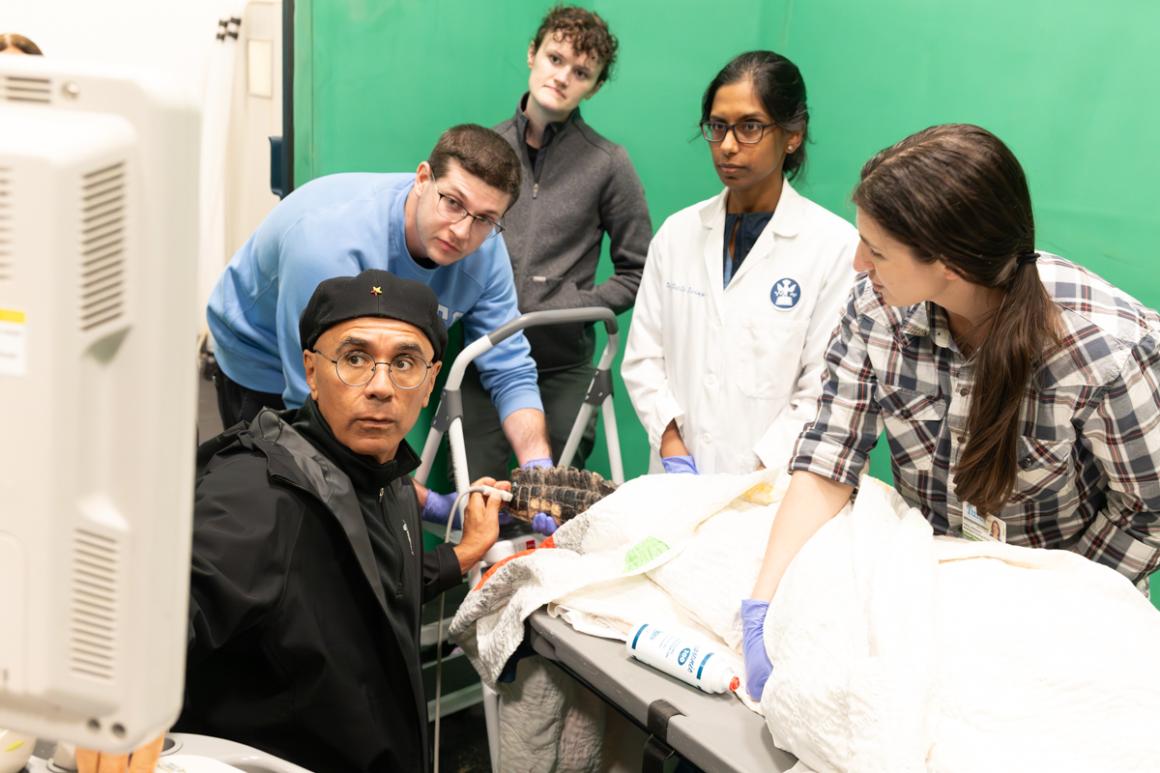
The ZCAM and Internal Medicine teams decided the best method of extracting the toy was by endoscope, a scope affixed with a camera and light to view a patient internally for diagnosis or treatment. The Internal Medicine team performs endoscopies regularly at FHSA. They planned to insert the endoscope through Allie’s mouth while she was under anesthesia to visualize the Kong, and thread umbilical tape (cotton tape most commonly used to tie off umbilical cords) through the Kong via scope guidance and pull out the toy.
“We met in advance and came up with a Plan A, Plan B, and Plan C,” says Barboza.
Allie arrived at FHSA in a crate with her mouth taped shut for safety. The Anesthesia and ZCAM teams began with front limb sedation. The Diagnostic Imaging team aided them via ultrasound to find a blood vessel to inject the anesthetic agent. The alligator was intubated once asleep, using PVC piping around the tubing in the oral cavity to protect the line and arms. Even under anesthesia, precaution is taken as the muscles that close the jaw can be stimulated, resulting in an extreme bite force.
“Alligators have a unique oral anatomy. It was great for the interns and residents to see the gular fold, the cartilage in the mouth that separates the airway from the oral cavity, so that alligators can catch prey underwater without inhaling water,” says Barboza of intubating the alligator.
The Diagnostic Imaging team then performed the CT scan, locating the Kong in Allie’s stomach. The Internal Medicine team was up next for the endoscopy. They inserted the scope through the PVC piping into Allie’s stomach. After visualizing the Kong through the scope, they attempted to tie the umbilical tape around the toy.
“It was extremely challenging to thread the umbilical tape through the Kong and pull it out,” says Barboza.
Barboza and the Internal Medicine team finally managed to twist the toy with manual maneuvers and extract it. Allie tolerated the anesthesia well through the procedure, recovered smoothly, and returned to the aquarium the same day.
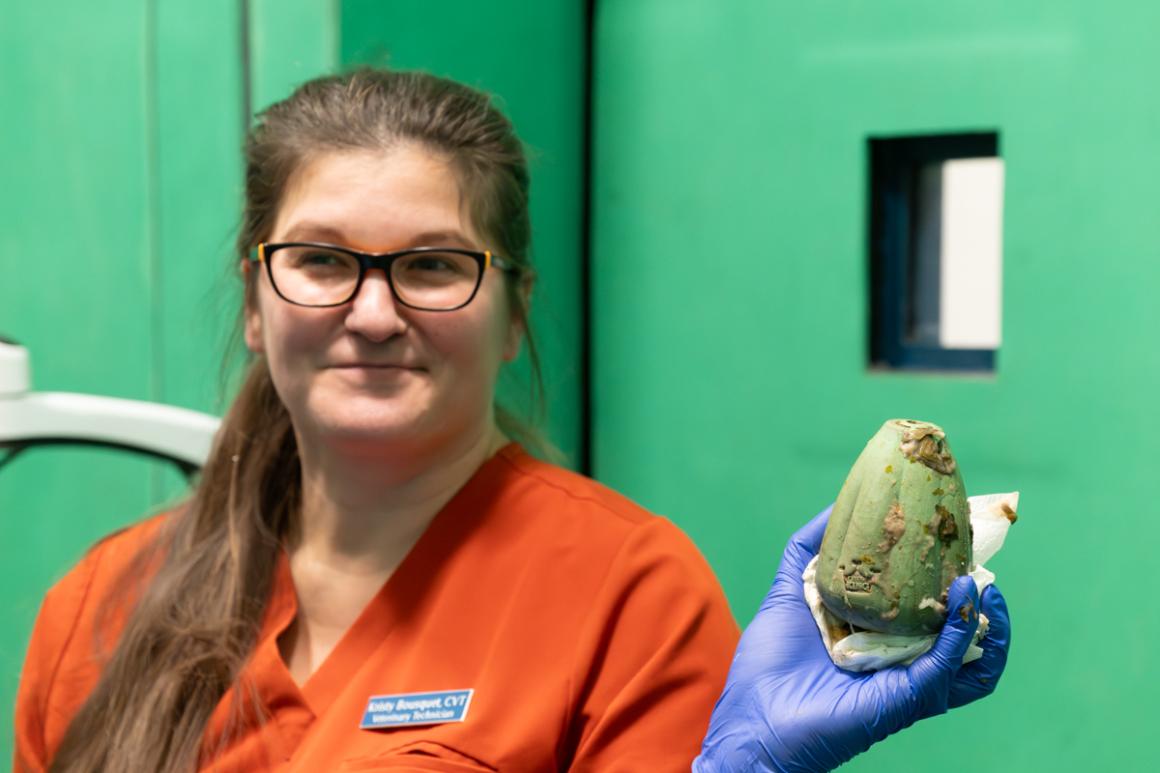
“When the Kong was resistant to coming out, we were a little worried, but the team operating the scope did a fantastic job,” says Fabbricotti. “Dr. Barboza was incredible with keeping us involved and updated throughout the entire procedure. The Anesthesia team was also amazing in Allie's recovery. We felt we made the best choice of care for Allie, taking her to Tufts.”
Barboza likewise credits Fabbricotti as extremely helpful and supportive throughout the process of extracting the toy.
Allie has since made a full recovery. She is back living on exhibit, eating well, and demonstrating behaviors indicative of low stress, according to Fabbricotti.
This alligator highlights how broad our expertise is in the zoological medicine field. ZCAM can provide care for any species of animal, and we’re lucky to have access to the other services that bring their own specialized knowledge and skillsets to help us treat the most unique species. Internal Medicine has extensive experience using flexible endoscopy to remove foreign objects. Diagnostic Imaging has a specialized skillset to find tiny vessels and interpret CT scans. Anesthesia is well versed in anesthetizing and recovering many different species. The collaboration in our hospital is something to be proud of as we provide care for all these animals.
Dr. Trinita Barboza
Department:
Foster Hospital for Small Animals