Anwen Burwick, VG26
Biography
Massachusetts
M.S. in Conservation Medicine ‘26
Biology
University of Massachusetts-Amherst 2025
Why did you choose to pursue this degree, and why did you choose Cummings School of Veterinary Medicine to pursue this degree?
I chose Cummings School of Veterinary Medicine because its Conservation Medicine program focuses on the interconnectedness of global health and emphasizes the importance of an interdisciplinary approach to addressing One Health issues.
What are your interests and/or experience relative to conservation medicine?
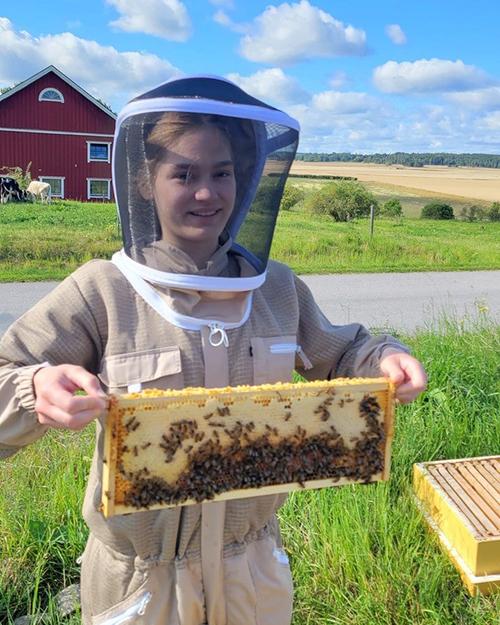
I spent the summer in Uppsala, Sweden working in The Honey Bee Research Centre at the Swedish University for Agricultural Sciences, where I researched topics in bee ecology, specifically virus transmission through Varroa mites, a parasite of honeybees, and the implications for wild pollinators. This experience exemplified the possibilities of collaborative research and how different perspectives applied to one problem drive progress toward solutions.
My interest in conservation biology and ecology stems from my upbringing on a farm in rural Massachusetts, and a desire to understand some of the more challenging aspects of conservation, in particular protecting ecosystems and biodiversity from the pressures of increased agricultural production. This complicated balancing act of human-animal-ecological interactions requires adaptive strategies to balance agriculture interests with the management and health of natural ecosystems.
What are your career goals after completing the program?
After completing the MCM program, I plan to pursue a Ph.D. in wildlife ecology or a related field and eventually work for a conservation organization.