Student Summer Researcher: Alden Smathers, V29
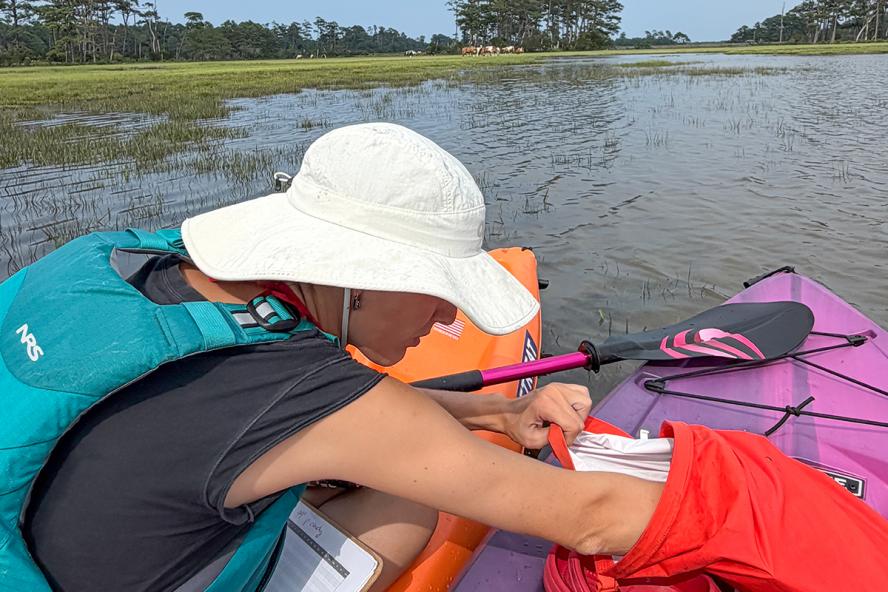
The summer research program and the opportunity to display their accomplishments during Research Day fully engage students in the process of advancing veterinary medicine and our understanding of human-animal relationships. These experiences broaden their perspectives wherever their careers may take them. So much cool work on wild horse behavior and humane management has been done at Assateague Island. I’m excited for Alden to extend that tradition!
Allen Rutberg
Bands of wild horses roaming Assateague Island were closely observed this summer by Alden Smathers, V29, a dual-degree D.V.M./Master of Science in Public Health (M.P.H.) student at Cummings School of Veterinary Medicine at Tufts University, for the Student Summer Research Program. Her research project was on display at the 37th Annual Veterinary Research Day on September 11.
“Alden is taking a new look at a challenging problem, which is how to evaluate well-being in free-roaming wildlife,” says Smathers’ advisor Dr. Allen Rutberg, director of the Master of Science in Animals and Public Policy (MAPP) program and associate research professor in the Department of Infectious Disease and Global Health at Cummings School. “Because standard measures of animal welfare don’t translate well to wildlife, Alden is exploring ways to measure agency, independent decision-making in wild horses living in herds that are managed in very different ways.”
As an undergraduate at New York University, Smathers majored in anthropology and worked in the WATR-lab, focused on fish and aquatic animal welfare and behavior studies.
“I've always been interested in humans and human culture as well as animals and animal behavior and welfare, and how we intersect and interact with each other,” says Smathers. “I'm interested in the intersection of public health and veterinary medicine, whether you're talking about zoonotic disease or the horses I'm working with now.”
Smathers first crossed paths with Rutberg when he spoke on equine welfare at a lunch talk hosted by Cummings School’s Welfare and Behavior Club. He discussed current measures of animal welfare, noting that they apply more aptly to animals in captivity than in the wild. His talk struck a chord with Smathers, and afterward, she posited the idea of a research project. They met over the semester to flesh out the idea, also consulting with Dr. Liv Baker, a conservation behaviorist who studies rewilding of elephants. She decided to pursue a comparative study of the wild horses on Assateague Island.
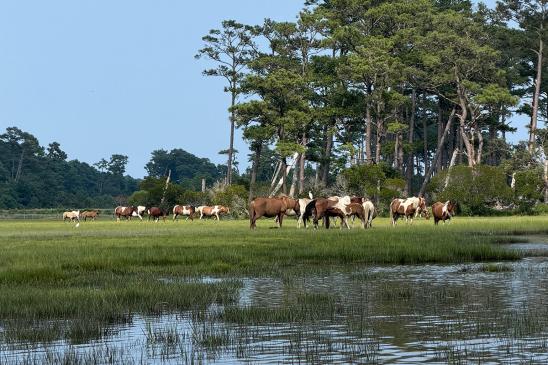
Off the East Coast, Assateague is a 37-mile-long barrier island, with a state line dividing the island between Maryland and Virginia. The northern horses on the Maryland side number 83, while approximately 150 horses roam on the southern half of the island in Virginia (not including foals). The Maryland-side horses are managed by the National Park Service using non-invasive birth control. The Virginia-side horses, owned by the Chincoteague Fire Department, live on a national wildlife refuge managed by the United States Fish & Wildlife Service (USFWS) and are rounded up by the fire department annually for the sale of foals.
Smathers set out to measure behavioral outputs of welfare and autonomy by comparing the Virginian and Maryland horses. She applied for permits to conduct the observational research to USFWS, the National Park Service, and Maryland State Park. Over 10 weeks, she observed three bands of horses in Maryland and three in Virginia. The horses are genetically similar, separated by a state line and different forms of human intervention for population control.
“They're phenotypically distinct horses,” says Smathers. “They are shorter than regular horses. Their noses are shorter, and they're pot-bellied because they consume a lot of salt in their diet and the water they drink.”
For the Applied Practical Experience required by her M.P.H., Smathers also secured an internship on the island with the Maryland Department of Natural Resources, helping manage human-horse interactions. Throughout the summer on Assateague, she spent three days a week at her internship and the other four observing bands of horses and collecting data on their behavior.
“Depending on the week and my schedule, I was either looking at the bands on the Maryland side or driving an hour down to Virginia, kayaking four miles into the marsh, and sitting there for a few hours watching the horses. I learned a lot about fieldwork, going through the mud and walking through trails and dunes,” says Smathers, who learned to kayak during the project.
To measure agency, Smathers created an ethogram of behaviors specific to wild horses, under the guidance of Rutberg and Baker. She observed the horses’ behavior and band dynamics with two-minute timestamps. She noted the focal horse of her observations, other horses in sight, any pertinent human activity, location, weather, and other factors in addition to the horses’ behaviors.
“I honed in on the strategy of taking narrative, longer-form observations and creating a codebook that encompasses all of the behaviors. It's backward from typical ethogram,” she says.
Smathers tracked posturing behaviors, such as alertness with ears pointed in a specific direction or toward an individual, napping, and lying down, and active behaviors, like walking and running, among many others to ultimately create a social networking map.
“In addition to the social networking web, we want to look at their behaviors in terms of autonomous transitions, a good marker for wild animal welfare. That would be meaningful changes in behavior that are conscious, whether initiated by the focal horse, another horse in their band, a horse in a different band, or human-initiated,” she explains.
Smathers is currently coding all of the horses’ behaviors for a larger analysis.
On her summer in Assateague Island, Smathers says, “I’m a dive-right-in kind of person, especially with animal behavior, and being on an island with horses, personally I had a great time and learned a lot. It was important for me to be very present in it, to keep learning, keep adapting, and try to do justice to the behavioral observations as much as I can.”
Smathers showcased her study, “Assessing Behavioral Indicators of Welfare and Agency in Free Roaming Horses,” on Veterinary Research Day last Friday.
“The summer research program and the opportunity to display their accomplishments during Research Day fully engage students in the process of advancing veterinary medicine and our understanding of human-animal relationships. These experiences broaden their perspectives wherever their careers may take them,” says Rutberg. “So much cool work on wild horse behavior and humane management has been done at Assateague Island. I’m excited for Alden to extend that tradition!”
Spending a summer observing horses in the wild set off more lines of inquiry for Smathers.
“I was thinking about how we define wildness, especially for feral or liminal populations,” says Smathers. “The horses, brought to this island 300-plus years ago and being around so many humans, have obviously adapted to live very unique lives. How much of that was influenced by humans? Are we still considering that wild? Does that mean we have different obligations to them? These are greater philosophical questions.”