Rosie’s response was the first of its kind. She had an amazing partial response to treatment. Seeing a sarcoma which is known to be resistant to chemotherapy and immune therapy have such a dramatic response was truly remarkable. Rosie also had very few side effects from the treatment.
Novel Immunotherapy Shows Promise in Clinical Trials at Cummings School
A cancerous tumor in a Golden Retriever disappeared after six weeks of infusions after being enrolled in a clinical trial, which helped to give her more time with her owners
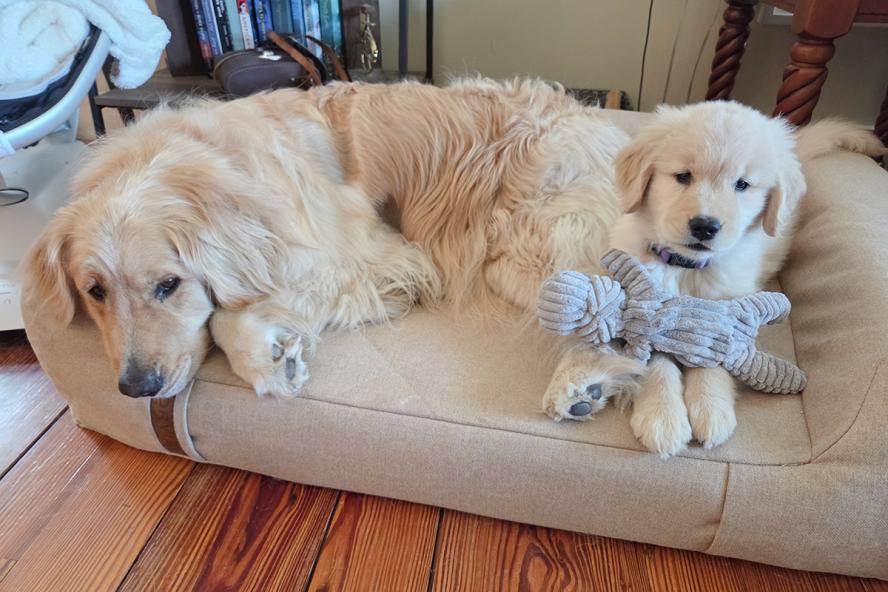
Rosie’s cancer came on fast and spread quickly. It progressed so aggressively that standard cancer treatments would have little benefit. The two-year-old Golden Retriever enrolled in a clinical trial for a novel immunotherapy at Cummings School of Veterinary Medicine at Tufts University. Within six weeks, the soft tissue sarcoma on her shoulder had completely disappeared, and only traces remained of the metastasis to her lungs.
“We had the entire summer. Besides treatments every week, day-to-day life overall didn’t change,” says Rosie’s owner, Michael Grinnell.
Rosie accompanied Grinnell to the office each day. “She loved to see all the guys. She’d lie in front of my desk. She loved to give love,” he says of bringing her along to the millwork company he owns in Rhode Island.
No symptoms of her cancer were evident until a lump began to grow on her left shoulder. Last June, she was diagnosed with soft tissue sarcoma, a rare type of cancer that can develop in soft tissue cells throughout the body. The sarcoma had already metastasized to her lungs by the time it was detected. She also had a tumor spread to her liver.
“The tumor on her shoulder in late winter was smaller than a golf ball. By June, it was the size of a baseball,” says Grinnell.
Rosie was referred to the Harrington Oncology Service at Henry and Lois Foster Hospital for Small Animals (FHSA) at Cummings School. With the aggressive nature of the tumor and rapid spread, standard cancer treatment was unlikely to be helpful, as sarcomas are notoriously resistant to chemotherapy. The FHSA medical oncologist suggested a clinical trial happening at Cummings School for a novel immunotherapy.
“With her diagnosis, she had a month or two left to live, and with her age, she was a good candidate for the clinical trial. It was worth a shot to get some time with her,” says Grinnell.
The Clinical Trials Office at Cummings School is dedicated to advancing the diagnosis and care of veterinary patients and guiding the development of treatments for both veterinary and human patients. Ongoing at Cummings School are a number of clinical trials of new therapies, procedures, diagnostic tests, and devices to treat cancer, kidney disease, arthritis, neurologic conditions, and other diseases.
A pilot clinical trial funded by the Department of Defense was recommended for Rosie. Run by the National Cancer Institute, this study evaluated a novel immune therapy, BG34-200, developed by Dr. Mei Zhang at Case Western University, in dogs with cancer to identify the optimal dose and regimen before testing in people with cancer.
Derived from purified oat bran, BG34-200 is an immune stimulant that activates white blood cells to kill cancer cells. The medication is being trialed for its efficacy against various forms of cancer through immunotherapy, a type of treatment that stimulates the body’s immune system to destroy cancer cells. BG34-200 activates two types of white blood cells that aid the immune system, monocytes and macrophages. Monocytes form in the bone marrow, travel through the blood to tissues throughout the body, and evolve into macrophages in the tumor microenvironment, which can then directly kill cancer cells. These activated macrophages can also more effectively help stimulate T cells, which are important for generating a strong immune response against the tumor.
Preclinical trials in mouse models of cancer showed promising results in stimulating immune cells and reducing tumor growth and metastasis in several types of cancers, with no negative side effects in the mice. Much of the research into BG34-200 has focused on the treatment of advanced melanoma (skin cancer) and osteosarcoma (bone cancer). The U.S. Food and Drug Administration granted BG34-200 orphan drug designation for treating osteosarcoma.
This clinical trial at Cummings School examined the appropriate dosage of BG34-200 in a variety of cancers that occur naturally in pet dogs. The dogs enrolled in the study received four weekly intravenous infusions of BG34-200 in the trial, and if the cancer responded to the treatment, the patient could continue to receive infusions every other week.
“Every Tuesday, we’d go in and drop her off for an hour or two. They gave her mild sedation for the infusion. She would come back happy as ever. She never showed any signs of fatigue or anything during infusions. She had zero side effects,” says Grinnell of Rosie’s experience in the clinical trial.
Throughout her course of treatment, Rosie had a full summer with the Grinnells—boating, taking walks, and playing with Dottie, a Golden Retriever puppy that recently joined the family. The Clinical Trials team liked to joke with Grinnell about whether he and Rosie would be taking out the salt pond boat or an ocean-going boat each weekend.
“Every single person at Tufts [Cummings School]was absolutely amazing,” says Grinnell. “Everyone had great compassion and care for Rosie. Any questions, they were only a phone call or text away. I could text the head of the clinical team at seven a.m. and get the text back in five minutes.”
After the second infusion, Rosie responded to treatment. By the end of July, after four treatments, the tumor in Rosie’s shoulder was gone. The tumors in her lungs had reduced by over 90 percent. Unfortunately, the tumors in her liver did not respond as well, and she eventually developed spread to her heart.
“Rosie’s response was the first of its kind,” says Dr. Cheryl London, V90, associate dean for research, Anne Engen and Dusty Professor in Comparative Oncology, and research professor in immunology in the Department of Small Animal Clinical Sciences at Cummings School. “She had an amazing partial response to treatment. Seeing a sarcoma which is known to be resistant to chemotherapy and immune therapy have such a dramatic response was truly remarkable. Rosie also had very few side effects from the treatment.”
Grinnell planned to continue infusions every other week, however Rosie developed a dangerous heart arrhythmia (irregular heartbeats) secondary to her tumor spread, and despite multiple attempts to control it, the arrhythmia continued and made it impossible to treat her further.
“From August to the end of September, we were trying to treat her arrhythmia more than cancer,” recalls Grinnell.
Despite the success of the new treatment in shrinking her tumors, with the complications from her heart arrhythmia, sadly, Rosie passed away this past October.
The clinical trial was completed at the end of September. Rosie’s participation in the trial provided meaningful data to inform the future direction of the medication, potentially helping other animals and humans with cancer. Importantly, all the other dogs enrolled in this study experienced few side effects, aside from some instances of nausea and vomiting, and three treated dogs had their disease stabilize (stop growing) during treatment. These exciting results have led to a follow-up study at Cummings School of BG34-200 in dogs with oral melanoma (mouth cancer), also funded by the Department of Defense.
The night before Rosie passed away, Grinnell and his daughter Charlotte took one last walk with the Golden Retriever in her stroller.
“I believe the infusions gave Rosie a great quality of life over the last six months,” says Grinnell. “She lived life to the fullest.”
Department:
Foster Hospital for Small Animals