Bringing policy and advocacy into a career devoted to caring for animals
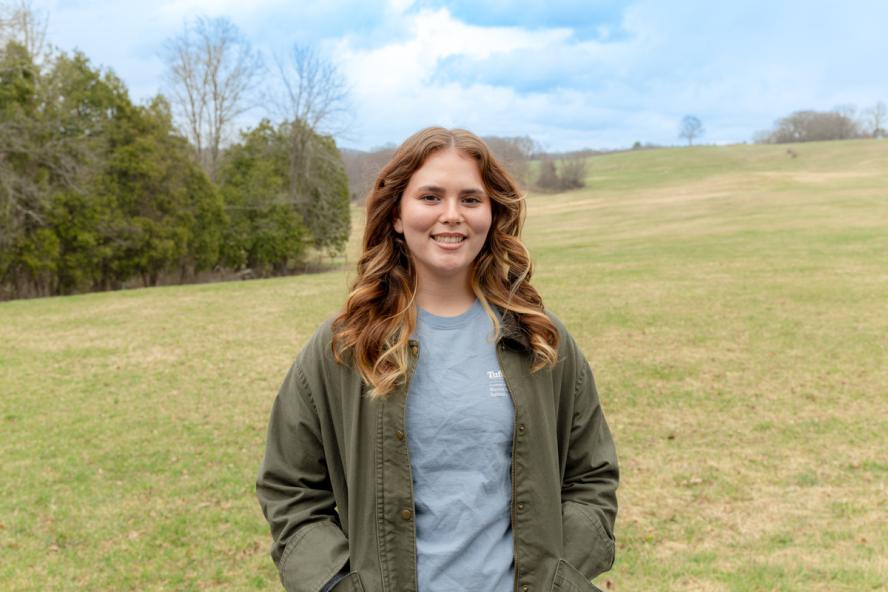
Esther Cuyjet, VG26 (she/her), student in the Master of Science in Animals and Public Policy (MAPP) program at Cummings School of Veterinary Medicine at Tufts University. Photo: Jeff Poole, Cummings School of Veterinary Medicine
As she prepares for the next step in her career, Esther Cuyjet, VG26 (she/her), is complementing her background in conservation, wildlife rehabilitation, and animal husbandry by earning her Master of Science in Animals and Public Policy (MAPP) at Cummings School of Veterinary Medicine at Tufts University.
“The MAPP program focuses on the human-animal connection and relationship, whether it's wildlife, zoo animals, companion animals, or lab animals. It’s perfect for me,” Cuyjet says. “It’s really going to help me move forward in my career to integrate that into my work.”
Animals have always been front and center throughout Cuyjet’s life. Since she didn’t have any pets of her own, aside from the occasional goldfish, she became the neighborhood dog walker and pet sitter.
“I knew all the animals in all of the houses on my street. I was living vicariously through my neighbors,” she says with a laugh. (Cats finally joined her family when she was in middle school.)
From a young age, Cuyjet originally planned to become a veterinarian and stayed set on that path until college. She grew up riding horses at a barn near her home in Virginia. In high school, she completed two years of veterinary science career readiness courses and worked at the barn, tending to the horses. As an undergraduate at the University of Mary Washington, Cuyjet started on the pre-veterinary track and served on the Pre-Veterinary Club’s leadership team. She worked as a veterinary assistant at a clinic and as a dog groomer.
An internship at the Center for Wildlife in Maine during the summer before her junior year piqued her curiosity about other possibilities in the field. The center treats native wildlife, including songbirds, squirrels, ducks, seabirds, and birds of prey.
“That was my first time working with animals other than dogs, cats, or exotic pets. After my internship, I realized that the people I was working with were doing the work I wanted to do, whether it was with those native wildlife species or another species. They're connecting with the public in a way that I want to connect with the public about animals. And so I pivoted,” she says.
After the internship, Cuyjet switched her major to conservation biology, with a minor in environmental sustainability. Following graduation, Cuyjet was hired as an associate zoological specialist at Busch Gardens in Williamsburg, Virginia.
“That job at Busch Gardens felt like the culmination of years of my life working towards trying to find what exactly I wanted to do with animals,” she says. “I love being able to bond with animals to make sure they're happy, healthy, and well taken care of. I enjoy talking to people about those animals—talking to the general public and talking to kids who, in my opinion, have the best questions about animals.”
Cuyjet cared for the Clydesdale horses at Busch Gardens, in addition to Highland cattle, sheep, Border Collies, barn owls, lorikeets, bald eagles, and other birds of prey. When two young Clydesdales joined the park, Cuyjet helped behavior-train the horses from the early stages and acclimate them to the bustle of the park.
“That was my first introduction to positive reinforcement training in animal behavior,” she says. “It ignited this fascination for me about training and behavior. I'm hoping to pursue or integrate training in some way in my future career.”
The MAPP program focuses on the human-animal connection and relationship, whether it's wildlife, zoo animals, companion animals, or lab animals. It’s perfect for me. It’s really going to help me move forward in my career to integrate that into my work.
Esther Cuyjet, VG26
The MAPP program was the perfect fit for her interests. Students in the one-year graduate program gain the skills and expertise to effectively advocate for animal well-being and to elevate human-animal relationships. MAPP courses examine government policies and laws regarding animals, as well as the evolving role of animals in society. Electives hone in on specialized areas of interest. Students develop their communication, writing, and research skills while learning about lobbying and other advocacy methods. MAPP students also participate in a three-month mentored externship or conduct a capstone research project.
The MAPP courses are stoking Cuyjet’s interests in various areas of animal advocacy, from helping marine mammals released from captivity to addressing proposed legislation to roll back protections for big cats. In the Animal Behavior elective, Cuyjet is digging deeper into animal training, learning the psychology behind the techniques she practiced at Busch Gardens.
On the tight bond that has formed among her MAPP cohort, she says, “We're a good mix of interests and corners of the animal world that we're interested in. We're all cheering each other on.”
Cuyjet also appreciates the faculty's support. “The professors tell us they're going to be in our corner for the rest of our careers—and they're doing it already, helping everyone find connections for summer externships. The professors have been wonderful teachers, mentors, and advisors.”
This summer, Cuyjet will intern at the New England Aquarium in Boston, caring for the penguin colony.
“I’m so excited to learn from the experienced keepers and trainers at the New England Aquarium and to work with a species I have never worked with before.”