Dressage Horse with Complex Symptoms Benefits from Asthma Research Study

As veterinarians, we are often confronted with clinical problems we haven’t encountered before—horses may have a disease we need to characterize better, or we have a lack of response to treatment and need to investigate a new medication. Clinical research is a way of moving treatments and diagnostics forward. One of the goals of a university setting is to generate and contribute to that body of knowledge.”
—Dr. Daniela Bedenice, professor in the Department of Large Animal Clinical Sciences at Cummings School and Marilyn M. Simpson Professor in Equine Medicine
Equine asthma affects more than 80 percent of stabled horses. Milder forms of asthma are difficult for owners to recognize and clinicians to diagnose. At Tufts Equine Respiratory Health Lab, Hospital for Large Animals (HLA) at Cummings School of Veterinary Medicine, clinical research is steadily advancing new technologies and methods of diagnosing and treating patients with inflammatory airway diseases like equine asthma. In the case of a dressage horse named Finn, a non-invasive lung function test developed in the lab was key to his diagnosis and recovery. In turn, Finn participated in a research study to optimize the early diagnosis of airway disease for future patients.
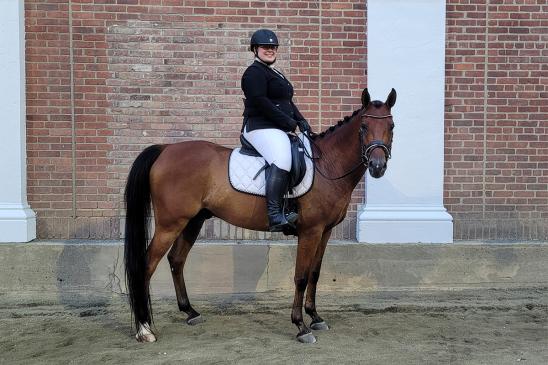
A purebred Arabian gelding, Finn, competes with his owner, Nikki Bickar, in USDF-rated dressage events and Arabian breed shows throughout New England.
“Finn likes to work, he loves treats, he loves his routine. He likes to think and be challenged,” says Bickar of her dressage partner.
Last summer, Bickar noticed Finn coughing more than usual. Their veterinarian initially suspected allergies. Finn’s cough progressively worsened, despite allergy medications, and interfered with riding, making him stop frequently to cough. A round of oral steroids resolved his symptoms initially, but his cough and exercise intolerance soon returned.
“We decided to take Finn to Tufts to do a fuller investigation to understand what was going on with him,” says Bickar.
Tufts Equine Respiratory Health Lab is the only place in New England with the expertise and advanced equipment to perform a complete respiratory workup, including lung function tests, to diagnose and treat horses with asthma. Equine asthma is often triggered by an environmental exposure, usually organic dust found throughout the barn environment. Severe asthma is accompanied by distinct clinical signs, such as cough and heavy breathing while at rest. Mild or moderate forms of asthma are often subtle, not obvious to the owner, and more difficult for clinicians to differentiate. Symptoms might include coughing during exercise, decreased athletic performance, or poor recovery from exercise.
When Finn was first seen at HLA last December, his chronic cough pointed to asthma. While chest radiographs showed changes suggestive of significant inflammation, sampling the lower airway via bronchoalveolar lavage, or lung wash, found only minimal airway inflammation that wasn’t typical of asthma. Due to the complicated nature of Finn’s condition, he required a more detailed respiratory work-up, including specialized lung function testing.
“Lung function testing is a critical component of characterizing different manifestations of airway disease, especially in situations like Finn’s, where it's not a straightforward presentation,” says Bedenice.
In contrast to bronchoalveolar lavage, which looks at the airway’s cell composition to identify inflammation, a lung function test best determines the ability of the respiratory system to move air in and out appropriately. In cases of mild or moderate asthma, baseline lung function testing is often normal, which happened with Finn. This means that a specialized challenge test, or “bronchoprovocation,” was required to identify abnormal airway reactivity, or “twitchiness,” of the lung that can limit a horse’s athletic performance.
Using a novel portable lung function testing tool developed by Dr. Melissa Mazan, V93, professor in the Department of Large Animal Clinical Sciences at Cummings School, the resistance of the horse’s airways can be measured non-invasively, to reflect airway narrowing either at baseline (severe equine asthma) or during challenge tests in horses with less severe disease. Typically, the horse inhales a stimulating agent, such as histamine, via nebulizer, while breathing naturally through a mask fitted over the nostrils and mouth. The horse’s response to the histamine is measured to see if the airways narrow excessively in response, decreasing the flow of air. Thickened and inflamed airways typically narrow more quickly, as was seen in Finn.
“Finn didn’t have much inflammation on lung wash, but showed quite a bit of airway narrowing with a very low concentration of histamine. These results helped diagnose lung disease while also guiding Finn’s treatment and measuring his progress on subsequent visits. We’re the only place in New England that can do these types of advanced airway diagnostics to see the whole picture of the patient’s health,” says Dr. Samantha Allan, large animal internal medicine resident in the Department of Large Animal Clinical Sciences at Cummings School.
Allan and her mentors are currently performing a clinical study in the Equine Respiratory Health Lab to optimize bronchoprovocation for horses with clinical signs of mild or moderate asthma—and Finn was a perfect candidate. The study compares histamine to hypertonic saline (concentrated salt solution) to diagnose airway hyperreactivity. In an ancillary study on nebulizers, Allan is researching the most effective methods to optimize the delivery of histamine and hypertonic saline.
Finn was the first horse enrolled in the study with the optimized aerosol delivery system. He was assessed on two separate days with hypertonic saline and histamine via nebulizer. After diagnosis, he was treated with both oral and inhaled steroids, and by the following month when Finn came in for a recheck, both his cough and chest radiographs had improved.
“On recheck lung function testing, Finn was no longer hyperreactive, which allowed us to stop oral steroids and continue only with inhaled medications,” says Allan. Six weeks later, his airway responsiveness to bronchoprovocation was completely normal. Bickar modified his barn to reduce dust exposure as a potential trigger and ensured he spends time outside daily.
On each visit to HLA, Finn participates in Allan’s study. HLA clinicians and Bickar are still determining the minimum amount of treatment Finn needs to remain symptom-free. Bickar plans to compete with Finn in upcoming dressage events.
“The more we try new things and investigate further, the more we learn about different disease processes. Finn came in as a clinical case, and his owner partnered with us by bringing him for follow-ups as part of our study,” says Allan.
The team’s current research studies are among many coming out of the Equine Respiratory Lab focused on establishing new lung function testing diagnostics and treatments. For example, a recently published study from the lab investigates a potential novel treatment for equine asthma using nebulized lidocaine. Another study examines the possible role of vitamin D in the development of asthma. HLA clinicians also work with outside collaborators on translational research, which leverages expertise related to the One Health concept of diseases that occur both in animals and people.
The Tufts Equine Bronchoalveolar Lavage Laboratory, run by Mazan, receives more than 300 cytologies from around the country each year for analysis of airway inflammation in horses. The Equine BAL lab recently showed that horses from the West Coast are more likely to have silicate-like particulates in their lower airways and have an inflammatory signature that is different to that seen on the East Coast, reflecting a possible involvement of climate change and increasingly arid conditions in the West.
Clinical research directly benefits HLA clients like Finn, struggling with asthma and other respiratory problems not responsive to traditional treatments.
This summer HLA completed their enrollment of horses with respiratory issues, comparing different forms of bronchoprovocation (airway challenge tests). Results will become available later this year to further improve our ability to help horses like Finn.