German Shepherd in Clinical Trial Still in Remission Five Years After Lymphoma Diagnosis
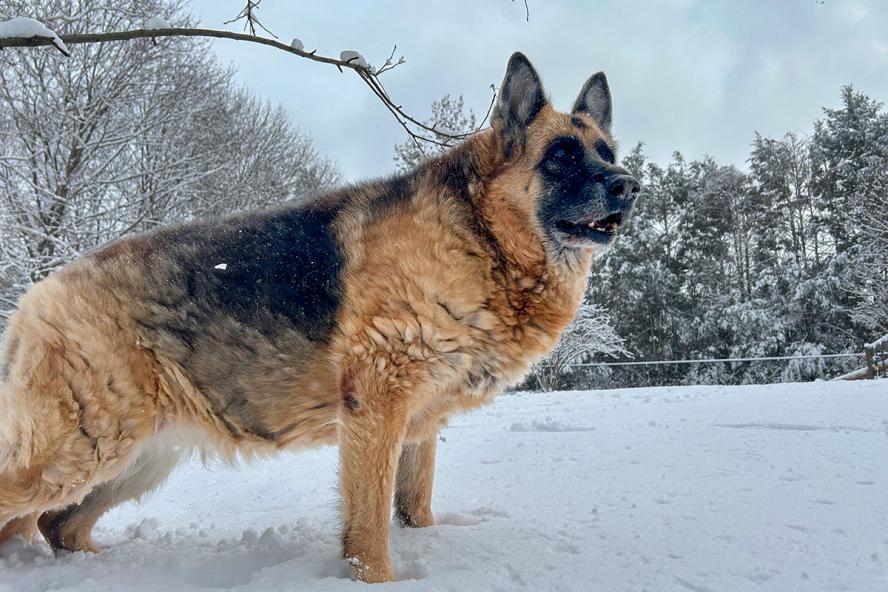
A German Shepherd named Brooke is coming up on her thirteenth birthday due in large part to her participation in a clinical trial at Cummings School of Veterinary Medicine at Tufts University. The trial tested a chemo-immunotherapy to treat B-cell lymphoma and increase the time before a patient comes out of remission, with exciting results.
More than 35 percent of the dogs in the clinical trial were alive 2 years after treatment (compared with an average survival of 1 year with chemotherapy alone). Others, like Brooke, are still running around today, putting long-term survivorship at approximately 20 percent, potentially cured by the chemo-immunotherapy treatment.
Brooke’s owner, Paul Giudice, enrolled her in the clinical trial at Cummings School. He had adopted Brooke when she was two years old, after she was rescued from a broken home. “Ever since, she's never left my side. She just loves life. She's very animated, loves food and being outside, and is all about her family. Brooke is almost like a human; if she had thumbs, she could do your taxes for you,” he says.
When Brooke was seven, in the winter of 2021, Giudice’s fiancé felt lumps on the dog’s neck while petting her. Their veterinarian ran bloodwork, revealing that Brooke had lymphoma, cancer of the lymphatic system that can affect lymph nodes, blood, bone marrow, the spleen, and other tissues in the body. The lymphatic system plays an essential role in the body’s immune response. Lymphoma originates in lymphocytes, white blood cells that fight disease and infection. Brooke’s cancer originated in her B lymphocytes, cells that produce antibodies.
Giudice’s fiancé researched clinical trials and came across the trial for dogs with B-cell lymphoma at Cummings School. Giudice had been to Henry and Lois Foster Hospital for Small Animals (FHSA) at Cummings School with previous pets. “I was familiar with Tufts [Cummings School]. Everybody there has always been wonderful.”
The Clinical Trials Office at Cummings School is focused on developing more effective, less intensive treatments for animals with cancer and other diseases that can potentially translate to human medicine. Funded by the National Cancer Institute, this trial evaluated the efficacy of combined immunotherapy with low dose single agent chemotherapy for the treatment of diffuse large B-cell lymphoma in dogs, with the intent to create a treatment with similar or longer remission times, higher survival rates, and less side effects than chemotherapy alone, and for the patients in the trial to achieve long-term remission.
Dose-intensive chemotherapy is the standard treatment for lymphoma in dogs and humans. Long-term human cancer survivors who undergo these treatments can experience impaired cognitive function or develop heart disease, which can lead to heart failure. Older patients may not be able to tolerate such an intensive regimen. To counter these effects, doses are sometimes reduced or eliminated, increasing the chance of relapse.
The trial was led by Dr. Cheryl London, V90, associate dean for research, Anne Engen and Dusty Professor in Comparative Oncology, and research professor in immunology in the Department of Small Animal Clinical Sciences at Cummings School.
“The goal of this study was to identify low-dose chemotherapy combined with immunotherapy that would give an equivalent outcome to standard high-dose chemotherapy,” says London.
The trial had several parts, the first testing different combinations of therapeutic regimens, with follow-up studies expanding the protocol. More than 70 dogs diagnosed with B-cell lymphoma participated in the trial. The patients received a chemotherapy drug (Doxorubicin or DOX) to reduce the size of the lymph nodes, an antibody (anti-CD20) to target the lymphoma cells, and one of three new immunotherapy drugs (KPT-9274, RV1001, or TAK-981) to stimulate the immune system.
Brooke received the TAK981 combination, which had shown positive results in mouse models of lymphoma. She was treated at FHSA five days a week for nine weeks. She felt nauseous during the first round of chemotherapy, but tolerated immunotherapy well, with few side effects. The treatment shrank all of her lymph nodes, and, typical of the majority of patients in the trial, a few weeks into treatment, she was officially in remission.
Brooke returned to the Clinical Trials Office for bloodwork and monthly monitoring of her lymph nodes over the next few years, until the trial concluded. Brooke sometimes felt anxious at follow-up visits, so the veterinary technicians invited Giudice to accompany her to reduce her stress. Brooke made unusual, but happy, vocalizations after each appointment.
“When we'd leave, Brooke would pull me out screaming this Chewbacca sound, with everybody laughing and cheering her on. Everybody involved was absolutely amazing, very friendly and always welcoming, like I was one of the team,” Giudice recalls. “She’s just a miracle.”
Brooke was one of many dogs to benefit from the trial. According to London, the chemo-immunotherapy combination markedly enhanced outcomes compared to chemotherapy alone. To evaluate progression-free survival (the time between remission and relapse) and overall survival time (from diagnosis to death), the subjects were divided into subgroups of five to seven dogs depending on the drug combination they received.
“One of the things that we can do very readily, which the human side cannot do, is use novel combinations up front and use small cohorts to try to tease out genetic differences that drive response to treatment,” says London.
The low-dose chemo-immunotherapy resulted in a markedly longer overall survival time compared with single-agent chemo alone (455 days versus 180 days). Most importantly, a larger percentage of dogs were alive at 2 years with chemo plus surgery compared to chemo alone (35 percent versus 15 percent). Lastly, the results of this less intensive regimen were comparable to those of the much more dose-intensive chemotherapy protocol typically used in both humans and dogs (termed CHOP).
“We were able to replace a high-dose, intense chemotherapy regimen with one that was a lot less dose-intensive by adding in immunotherapy,” says London. “We learned that it's much more tolerable when you're not giving dose-intensive chemotherapy—quality of life is better.”
Side effects in the trial were generally mild, significantly less than with chemotherapy alone. The remission rate for all dogs in the trial was close to 90%.
Among the patients that relapsed after chemo-immunotherapy, several that were re-treated in the trial responded quite well and went into long-term remission, which London attributes to a memory response in the immune system. The team also found that tumor gene expression strongly predicted the patient’s response to treatment.
“We found that there are gene expression patterns that match the immunotherapy used,” says London. “The genomics dictated the response. In the future, what we'd like to be able to do is match the genomic landscape to immunotherapy.”
Brooke remains fully in remission, quite healthy after participating in the trial.
“Tufts[Cummings School]has always been great for us, but the clinical trial was amazing,” says Giudice. “Without them in this process, she definitely would not be here today. Knowing that she probably helped develop something down the road is a good feeling, too.”