Dr. Eugene White Receives Fulbright Specialist Award to Advance Dairy Reproductive Education in Tanzania
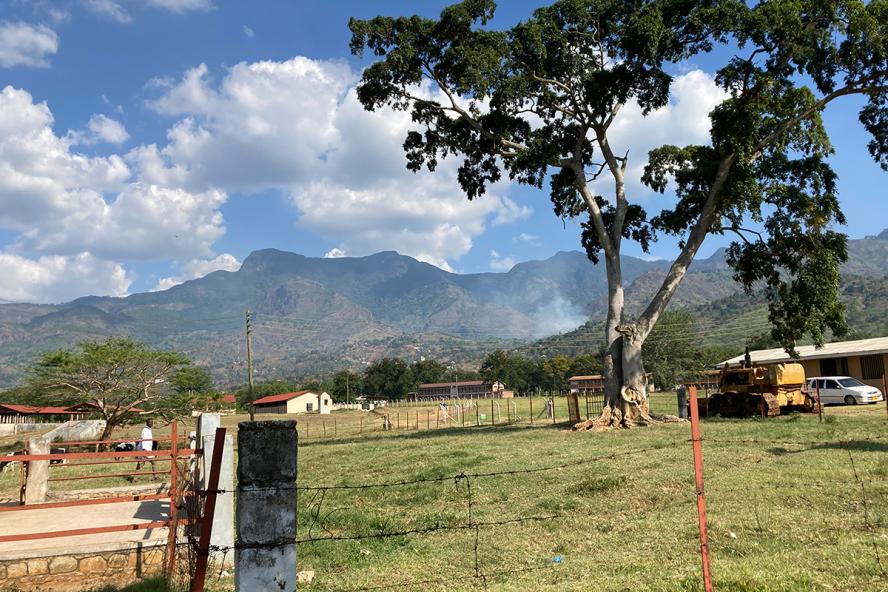
Fulbright Specialist Award recipient Dr. Eugene White was tasked with training veterinary faculty and students at Sokoine University of Agriculture (SUA) in Tanzania on the use of ultrasound in bovine pregnancy diagnosis and assisted reproduction. He drew on more than 30 years of experience at Cummings School of Veterinary Medicine at Tufts University, as the Amelia Peabody Foundation Chair in Agricultural Sciences and professor in the Department of Large Animal Clinical Sciences, practicing with Tufts Veterinary Field Service (TVFS).
The only veterinary school in Tanzania, SUA, has a pressing need for more expertise in livestock reproduction to support the country’s dairy industry.
“Tanzania’s population is skyrocketing, which means that its food needs are going to be skyrocketing also,” says White. “Tanzania is interested in using genetic selection for cattle that produce milk more efficiently because their population is growing so quickly.”
Located in Morogoro, SUA is a large university with 16,000 students, including 700 in the veterinary school. The faculty are highly educated, most with Ph.D.s in addition to veterinary degrees. The school has advanced equipment, a new diagnostic laboratory, a biotechnology lab for producing vaccines, and an in vitro fertilization (IVF) lab under construction. What SUA lacked was training in bovine assisted reproductive technology.
“Specifically, they want to be able to do in vitro fertilization of cattle,” says White. “Similar to humans, they want to collect eggs from cattle, fertilize them in the lab, mature them for seven days, and then either freeze them or transfer them into other cattle. The idea here is to multiply the number of offspring from genetically superior cattle because of the need to improve food security.”
White is one of 400 Fulbright Specialists selected annually by the U.S. Department of State and the Fulbright Foreign Scholarship Board to bring their expertise to institutions worldwide.
“Through this Fulbright experience, we are proud to have Dr. White sharing his expertise with faculty and students in Tanzania, while also laying the groundwork for future collaborative opportunities with this university,” says Dr. Carlos Pinto, Dorrance H. Hamilton Professor in Applied Reproductive Medicine and chair of the Department of Large Animal Clinical Sciences at Cummings School. “In addition to his significant contributions to veterinary education at Cummings School, Dr. White has also volunteered his time and expertise internationally, sharing his knowledge of cattle reproduction in Bangladesh, Bermuda, and now Tanzania. He worked particularly in underserved settings where access to advanced training in veterinary reproductive medicine is limited.”
To help prepare future vets with the knowledge and skills to address this need in Tanzania’s dairy industry, SUA requested a Fulbright Specialist with expertise in livestock medicine and reproduction to deliver lectures on reproductive management and provide hands-on training and labs in reproductive ultrasound.
“That’s what I do Monday through Friday,” says White.
As a dairy practitioner with TVFS, White visits commercial New England dairy farms to advise on herd health and reproductive services. Central to his work is teaching Cummings School students in the classroom and in the field. His most commonly practiced procedures are reproductive exams in cattle utilizing ultrasound. He places approximately 2,000 embryos annually in recipient cows and creates embryos by conducting embryo flushes in super-ovulated cattle. Additionally, he was part of the SVF [Swiss Village Foundation] team that produced rare-breed cattle embryos, now housed at the Smithsonian Institution in Washington, DC, to reintroduce any breeds should they become extinct.
Bovine reproductive medicine offers numerous benefits to the agricultural community, according to White. The largest benefit is increasing the number of heifer calves. Cows typically have one calf per year. By transferring embryos, several calves can be birthed annually from one genetically superior cow. Gender-sorted semen can ensure that all of the calves are female if a client needs more milk-producing cows, for example. Reproductive medicine can also provide an alternative source of income for farmers, often hit by fluctuations in milk and beef prices, by making embryos for their own herds, providing recipient uteruses for other farmers, or both. In Tanzania, dairy farms benefit from reproductive medicine, which increases milk supply and contributes to food security.
Over three weeks this past December, White visited SUA, hosting seminars, leading training sessions and labs, and developing curriculum materials on bovine reproductive management. Sidelined for a few days, first by a power outage and later by sequestration for five days in Dar es Salaam by the U.S. Embassy due to political unrest, he was still quite productive during his time there, teaching and training students and faculty. He delivered lectures on using ultrasound for dairy reproductive exams (for example, monitoring the reproductive cycle and pregnancy diagnosis), reproductive pathologies, cattle diseases, and other reproductive technologies.
White taught practical labs on bovine embryo transfer, with hands-on training throughout, including ultrasound and image interpretation. During a mock flush of a super-ovulated cow, he led the students in practicing a simulated epidural, catheterization of the uterus, running fluid through the uterus, collecting embryos in a filter, and examining the filter in the lab. He conducted a follow-up training session on embryo transfer into a recipient cow.
At the SUA school farm, White taught reproductive palpation and ultrasound with pregnant Holstein cross-bred females. Visiting a farm in Mzumde, where many of the newly weaned goats were dying, White and the students examined the herd of 200. They suspected Mycoplasma pneumonia and developed treatment and vaccination plans. They also tested a herd of 60 cows for Trypanosomiasis, a blood-borne disease spread by tsetse flies.
White worked closely with SUA faculty to guide integrating reproductive ultrasound technology into the curriculum and led exploratory research discussions on reproductive technologies.
SUA faculty and students were exceptionally welcoming, his faculty hosts taking White to Sanje Waterfalls and on safari through Mikumi National Park on the weekends.
White has previously shared his bovine expertise abroad. In Bermuda, he has consulted with farmers and government officials for more than a decade on increasing domestic milk production and maintaining food safety standards. As part of a United Nations initiative, he traveled to Bangladesh several times to deliver seminars to veterinary faculty on preventing and treating zoonotic diseases and on nutrition and preventive health to improve cattle food production.
While agricultural systems differ significantly between the United States and many other countries, shared expertise and technologies like reproductive ultrasound bring wide benefits to all. White explains that, for example, in the United States, cows produce an average of 80 pounds of milk a day, but do so on forage and grain grown specifically for them. Cows in developing countries typically produce about 8 pounds per day but are often fed by-products of food grown for humans, such as rice straw, mustard oil cake, and molasses, making efficient use of these by-products.
“That's always what strikes me when I go to developing countries, it's an entirely different framework on what livestock do—they convert inedible products into food for people, where we grow feed,” says White. “Even though their feeding system is entirely different, some of the technology we have here can be used to enhance their own systems.”