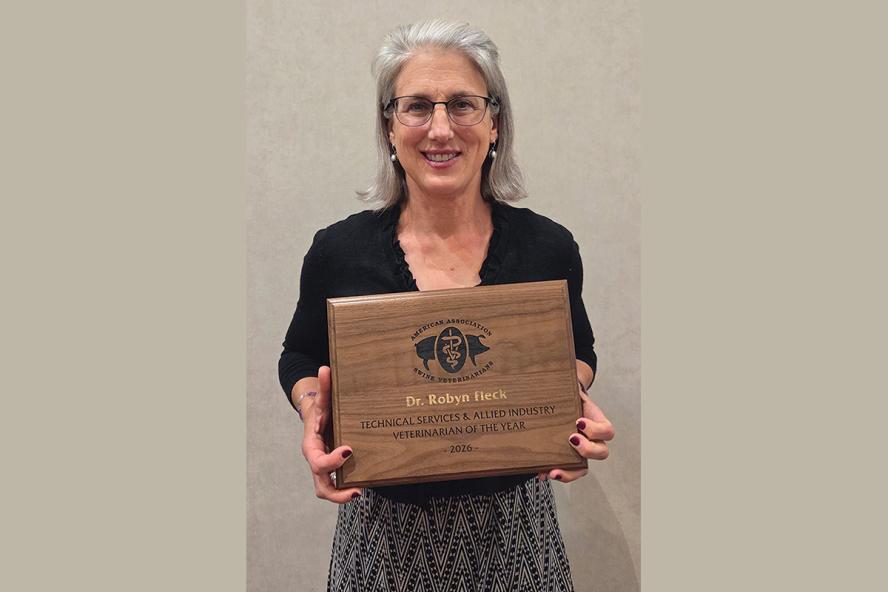
AASV Honors Dr. Robyn Fleck, V92 with the Technical Services/Allied Industry Veterinarian of the Year Award
Tufts [Cummings School] was very supportive and gave me the flexibility to go explore. I learned good medicine and how to think critically at Tufts [Cummings School]. You need that to be a good vet—and also have the freedom to go do something crazy, like pigs.
– Dr. Robyn Fleck, V92
The American Association of Swine Veterinarians (AASV) distinguished Dr. Robyn Fleck, V92 with the Technical Services/Allied Industry Veterinarian of the Year Award. A graduate of Cummings School of Veterinary Medicine at Tufts University, Fleck received the award for her contributions to the swine industry, to AASV, and to opening up a new career path for women in swine medicine.
“I consider it to be one of the greatest honors I’ve received in my life professionally. Having your peers think of you and vote for you is huge,” she says.
The AASV recognized Fleck as a trailblazer for women in the field of swine veterinary medicine when presenting her with the award at their 57th Annual Meeting this past March in Las Vegas, Nevada.
“There were little to no female swine vets when I started out, let alone female corporate swine vets. There was never a line for the bathroom,” she quips. “It was difficult at the beginning to be the only female in a male-dominated industry. I had some battle scars for sure, but I’m glad I did it. Now more women than men are going into swine medicine. I am proud of that.”
Dairy farming was part of the culture in her hometown of Gill, Massachusetts. When she was 12 years old, she started milking cows for her school’s farm program, and throughout high school, she also worked at a horse farm.
Fleck attended Bryn Mawr College and initially did not plan on a veterinary career. She took a year off from school to work with a documentary filmmaker, helping produce and edit two films about the history of nursing and the Adirondack Park. When she returned senior year, she switched her major from biology to chemistry.
As graduation approached, Fleck considered her career options. “I thought about where I was happiest growing up, and I was always happiest on a farm. By total luck, I had all the requisites for pre-vet because I changed my major.”
Fleck was a member of the ninth class to graduate from Cummings School (then called Tufts University School of Veterinary Medicine). The first two years of the program were then at the Boston campus, where she studied with the medical and dental students and exercised police horses outside of class. In Grafton for the last two years, her favorite memories were on “foal watch,” spending overnight shifts monitoring foals. She also took part in a summer research project extracting DNA and running early polymerase chain reaction (PCR) tests.
Pigs unexpectedly became her animal of specialty after two externships with veterinarians practicing dairy and swine medicine in Minnesota and North Carolina.
“I had never been around pigs before. I started to enjoy the pigs more than the cows. The pigs were physically easier for me to deal with,” says Fleck, who stands at five feet one inch. “I like the pig farmer mentality too, which is all about disease prevention. I came back to Tufts [Cummings School] and said, ‘That’s it, I’m doing pigs.’”
Fleck enjoyed working with Cummings School’s small herd of Large White pigs, where she diagnosed her first case of mange (Sarcoptes scabiei var. suis). She then organized a hog mange and lice eradication program using Ivermectin, a relatively new drug at the time. “It was so satisfying to relieve the pigs of discomfort and improve overall herd health,” she says.
The professors and excellent education especially stand out from her experiences at Cummings School. At the time of her graduation, pork production corporations were beginning to hire veterinarians in-house. Fleck joined Cargill Pork as a full-time staff veterinarian.
“I was one of the very first female corporate swine vets, and one of the first corporate vets, period,” she says.
At Cargill, Fleck was responsible for nearly 100,000 sows across Arkansas, Missouri, and Oklahoma. She focused on herd health, pork production, disease eradication, animal welfare, vaccination protocols, and regulatory issues. At first she worked independently, and when she needed assistance troubleshooting issues, she called the technical services veterinarians employed by various pharmaceutical and vaccine companies.
“There were no cell phones, no Internet, you couldn’t Google anything. All you had was the expertise of the people who came before you. I am grateful to all the tech service vets who helped me through those first few years. They set the bar for prompt and scientifically sound support,” she says.
To advance her expertise, Fleck traveled to university libraries in Iowa, Minnesota, and Wisconsin. “Not every library had the Proceedings of the International Pig Veterinary Society. I would hole up in a library for a week and read my journal articles.”
After eight years at Cargill, Fleck moved to Schering-Plough Animal Health as a swine technical services veterinarian, supporting their swine vaccines and pharmaceuticals. Her territory included the entire United States. She later covered international pork producers throughout Europe, Asia, and South America, witnessing firsthand how pigs are raised all over the world.
The National Pork Board hired Fleck as director of swine health programs, where she was integral to drafting the first version of the Swine Identification Plan. In the wake of 9/11, fighting bioterrorism was a top priority, and she worked closely with the Center for Epidemiology and Animal Health to monitor and protect against possible outbreaks of classical swine fever and foot-and-mouth disease. She served on the National Pork Board’s Swine Health and Food Safety committees as well as the National Institute of Animal Agriculture’s Food Animal Identification Task Force.
Returning to technical services at Intervet, Fleck supported a broad line of anti-infectives, vaccines, reproduction hormones, and dewormers. She also spent a portion of her career at Zoetis, as associate director of outcomes research, leading studies evaluating the benefits of their products for farmers.
Joining Merck Animal Health a decade ago, Fleck continues to work supporting a broad line of swine vaccines and pharmaceuticals. Based in Arkansas, she is senior account manager of scientific sales and affairs, providing technical service to a handful of large integrated pork production systems.
Throughout her career, Fleck has served on several AASV committees, including program planning, influenza, pharmaceutical issues, food safety, and, currently, diversity, equity, and inclusion. In addition to treading a new career path for women, AASV also cited Fleck’s commitment to mentoring students and newly practicing swine veterinarians.
For more than 10 years, Fleck has taught the swine section of the Farm Animal Medicines course at Cummings School. “It’s a good opportunity to spend a couple of days at my alma mater, visit students, and try to recruit for the pig industry,” she laughs.
Fleck reflects on her time at Cummings School, “Tufts [Cummings School] was very supportive and gave me the flexibility to go explore. I learned good medicine and how to think critically at Tufts [Cummings School]. You need that to be a good vet—and also have the freedom to go do something crazy, like pigs.”